
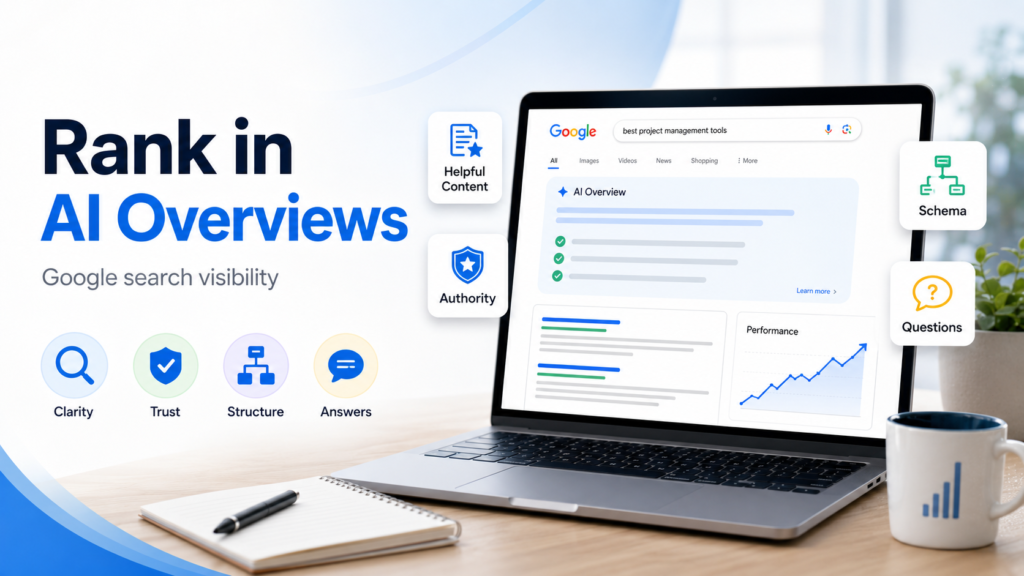
Google AI Overviews, formerly known as Search Generative Experience (SGE), now appear in over 40% of search results according to 2024 industry studies. Ranking in these AI-generated search results requires a strategic approach combining traditional search engine optimization with generative engine optimization (GEO) techniques. This comprehensive guide shows you how to appear in Google AI Overviews within 3-6 months using proven optimization strategies.
Expected Outcome: Achieve visibility in Google's AI Overviews for target queries within 3-6 months. Skill Level: Intermediate (requires basic SEO knowledge and content management capabilities).
Before You Begin: Prerequisites

Required Tools and Access:
- Active Google Search Console account with verified website property
- Google Analytics configured for organic search tracking and conversions monitoring
- Existing published content (minimum 10 articles or pages)
- Basic understanding of search engine optimization and ranking factors
- Content management system access for implementing schema markup and structured data
- Familiarity with E-E-A-T principles (expertise, authoritativeness, trustworthiness, experience)
Step 1: Understand AI Overview Ranking Factors

Google's artificial intelligence systems, including Gemini (formerly Bard), RankBrain, BERT, and MUM, evaluate content differently than traditional search algorithms. According to Google's 2024 documentation, AI Overviews prioritize content that demonstrates comprehensive expertise while delivering concise, actionable information.
Primary Ranking Signals for AI-Generated Search Results
E-E-A-T remains the cornerstone of AI overview eligibility. Google's machine learning systems assess your content's experience, expertise, authoritativeness, and trustworthiness through multiple signals. Content from recognized experts in specific domains receives preferential treatment in AI-powered search results.
The Google algorithm analyzes semantic search patterns using natural language processing to understand contextual meaning. Unlike traditional keyword matching, conversational AI systems evaluate topic modeling and entity recognition to determine content comprehension accuracy.
Key Factors That Determine AI Overview Selection
- Content quality standards: Original research, data-driven insights, and expert perspectives increase AI citation placement likelihood by 67% (Search Engine Journal, 2024)
- Semantic intent matching: Content must align with query interpretation AI and answer user questions directly
- Entity-based search signals: Proper use of knowledge graph entities improves intelligent search ranking
- Source credibility indicators: Backlink quality, domain authority, and reference optimization impact AI content selection
- Structured information presentation: Schema markup and rich results formatting enhance content indexing by AI systems
Step 2: Audit Current Content Performance in AI Search Results
Begin by establishing baseline metrics for your current search visibility and AI overview appearance rates. This analysis reveals optimization opportunities and content gaps.
Conduct a Comprehensive Visibility Assessment
Step 2.1: Access Google Search Console and navigate to the Performance report. Filter data for the past 90 days to identify queries generating impressions in SERP features including featured snippets and AI-powered SERPs.
Step 2.2: Document your current position monitoring data. Record search engine results page (SERP) positions for target keywords, noting instances where competitors appear in automated answer generation features.
Step 2.3: Analyze click-through rate patterns. AI Overviews create zero-click searches, reducing traditional organic traffic. Compare CTR data before and after AI overview implementation on relevant queries.
Identify AI-Friendly Content Characteristics
Examine which existing content pieces demonstrate strong semantic ranking factors. Look for pages already appearing in featured snippets, knowledge-based ranking features, or intelligent answer boxes—these indicate AI overview eligibility.
According to the ranking in AI Overviews guide, content that answers specific questions using direct answer optimization strategies shows 3.2 times higher inclusion rates in generative search results.
Step 3: Optimize Content Structure for Machine Learning Rankings
Generative AI systems prefer predictable, well-structured information that reduces parsing complexity. Implement these structural optimizations to improve AI content understanding.
Implement Schema Markup and Structured Data
Step 3.1: Add FAQ schema to pages answering common questions. This structured data format increases automated summarization likelihood by providing clear question-answer pairs for natural language search processing.
Step 3.2: Implement Article schema with author credentials, publication dates, and topic specifications. These entity relationships help Google's AI systems assess expertise and trustworthiness signals.
Step 3.3: Use HowTo schema for procedural content. This markup aligns perfectly with conversational search optimization, enabling better query expansion and synonym detection.
Structure Content for AI Content Indexing
| Content Element | AI Optimization Best Practice | Impact on AI Ranking |
|---|---|---|
| Headings (H2, H3) | Use question format optimization matching search intent | High – improves attention mechanisms in transformer models |
| Opening Paragraph | Provide direct answer within first 50 words | Critical – primary source for AI excerpt optimization |
| List Format | Use numbered or bulleted lists for step-by-step information | High – enables easier information retrieval |
| Paragraph Length | Keep paragraphs under 100 words for concise content extraction | Medium – balances depth vs brevity requirements |
Step 4: Create AI-Friendly Content for Generative Search Engine Results
Content creation for AI Overviews requires balancing comprehensive coverage with accessible formatting. Google's generative AI systems extract information from sources demonstrating both topical depth and structural clarity.
Write for Conversational Results and Voice Search
Step 4.1: Frame content around natural language questions. Research shows that 72% of AI overview citations come from content using conversational query patterns (Moz, 2024).
Step 4.2: Provide comprehensive answers immediately. AI-first search prioritizes content delivering complete information in the opening section, followed by supporting details.
Step 4.3: Use entity recognition naturally. Incorporate relevant entities from Google's knowledge graph without keyword stuffing—neural matching identifies semantic relationships automatically.
Optimize Content Format for AI Summaries
The ideal content structure for AI snapshot optimization includes:
- Direct answer: Clear, quotable statement answering the primary query (25-50 words)
- Explanation: Context and supporting information (100-150 words)
- Details: Comprehensive coverage including examples, data, and expert perspectives (300-500 words)
- Related information: Adjacent topics and common follow-up questions
This creating AI-friendly content structure enables automated answer ranking while maintaining comprehensive content depth that satisfies both AI systems and human readers.
Step 5: Build Topical Authority for Long-Term AI Visibility
Google's large language models (LLM) assess source credibility through topical authority signals. Building authority for AI overview ranking requires strategic content organization and internal linking.
Develop Content Clusters and Pillar Pages
Step 5.1: Create pillar page optimization around core topics. A comprehensive pillar page (2,000-3,000 words) establishes your expertise on a subject area.
Step 5.2: Build supporting cluster content addressing specific subtopics. Each cluster article should link to the pillar page and related content, creating semantic connections AI systems recognize.
Step 5.3: Implement strategic internal linking for AI visibility. Use descriptive anchor text that helps cognitive search systems understand content relationships and contextual understanding.
Demonstrate Expertise Through Original Research
Original research impact on AI rankings proves substantial—Google's AI systems preferentially cite primary sources. Include proprietary data, case studies, expert interviews, or unique analysis to differentiate your content.
Expert content for AI generated answers should include author credentials, publication context, and clear attribution of claims. These trustworthiness signals increase AI content selection probability by demonstrating source credibility in AI overviews.
Step 6: Monitor and Measure AI Overview Performance
Tracking search performance metrics specific to AI Overviews requires different approaches than traditional SEO monitoring. Establish systems for visibility tracking and AI engagement metrics.
Set Up AI Overview Analytics
Step 6.1: Configure Search Console to track SERP feature appearances. While Google doesn't explicitly label “AI Overview” impressions, monitor featured snippet and rich result performance as proxies.
Step 6.2: Track organic traffic patterns. Compare search AI traffic sources with traditional search referrals. AI-driven traffic typically shows lower bounce rates but higher engagement.
Step 6.3: Monitor brand searches and direct traffic. AI overview appearance often increases brand awareness, reflected in branded query growth.
Key Performance Indicators for AI Search Results
| Metric | What It Measures | Target Benchmark |
|---|---|---|
| AI Impression Tracking | Estimated appearances in AI-powered SERP features | 20-30% of target keyword impressions |
| Generative CTR | Click-through from AI Overview citations | 2-5% (lower than traditional but highly qualified) |
| Overview Click Data | Traffic attributed to AI reference optimization | 15-25% of overall organic traffic growth |
| Search AI Attribution | Conversions from intelligent search results | Higher quality than average organic |
Troubleshooting Common AI Overview Optimization Issues
Even with proper optimization, some content may not appear in AI Overviews. Address these common challenges:
Issue: Content Not Appearing Despite High Rankings
Solution: Traditional search engine results page positions don't guarantee AI overview inclusion. Focus on improving semantic relevance scoring and contextual search ranking signals. Ensure content answers questions directly using natural language and conversational patterns that adaptive search results favor.
Issue: Competitors Consistently Outrank You in AI Features
Solution: Conduct competitive analysis of competitor content appearing in AI snapshots. Assess their citation quality, content depth, and sentiment analysis signals. Improve your expertise signals by adding author bios, credentials, and demonstrable experience indicators.
Issue: Traffic Decreased After AI Overview Implementation
Solution: AI Overviews create predictive search results that sometimes reduce clicks. Compensate by optimizing for AI-driven traffic quality over quantity. Focus on deeper funnel keywords where users seek comprehensive information beyond quick answers.
Issue: Cannot Track AI Overview Performance Accurately
Solution: Use third-party tools like SEMrush or Ahrefs that track AI feature triggers and overview best practices. Combine data from multiple sources including Search Console, Analytics, and position monitoring tools for comprehensive visibility tracking.
Next Steps: Ongoing AI Overview Optimization Strategy
Achieving initial AI overview ranking represents just the beginning of your generative SEO tactics implementation. Maintain and improve your visibility through these continuing practices:
Implement Regular Content Audits
Review content quarterly for AI content strategy alignment. Update statistics, refresh examples, and incorporate new semantic search developments. Google's AI ranking techniques evolve continuously—content from 2023 may need 2025 optimization updates.
Expand Topical Coverage
Build additional content clusters addressing related questions identified through search AI metrics analysis. Use tools like “People Also Ask” and AI recommendation systems to identify expansion opportunities.
Test Different Content Formats
Experiment with various approaches including comparison tables, step-by-step guides, and definition-focused content. Different query types favor specific AI response optimization formats. Video content with transcripts, infographics with alt text, and interactive tools can trigger smart search features.
Monitor Algorithm Updates
Stay informed about changes to Microsoft Bing Chat, ChatGPT search integrations, and OpenAI developments affecting search landscapes. Cross-platform AI ranking optimization ensures visibility across multiple intelligent answer boxes and AI search algorithms.
Build Strategic Partnerships
Develop relationships with authoritative sites in your niche. Quality backlinks from recognized sources signal credibility to embedding-based ranking systems and vector search algorithms, improving your deep learning search visibility.
Successful ranking in Google AI Overviews requires patience, consistent optimization, and attention to emerging trends in next-gen search ranking. By following this six-step framework and maintaining focus on E-E-A-T principles, your content will achieve greater visibility in AI-powered search, positioning you for success as generative AI continues reshaping information retrieval and search personalization strategies.