
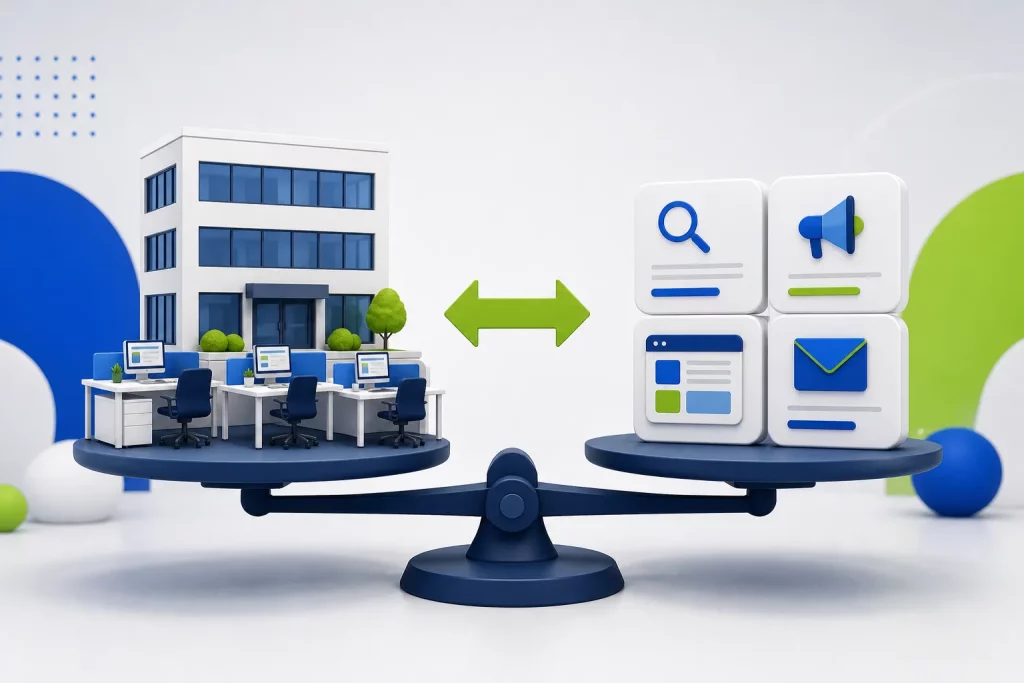
The difference between a marketing agency and an in-house team is who does the work and how you pay for it. An in-house marketer is your employee: close to the business, but usually strong in a few skills. An agency gives you a team of specialists for a fee, with less day-to-day presence. Many local businesses end up using both.
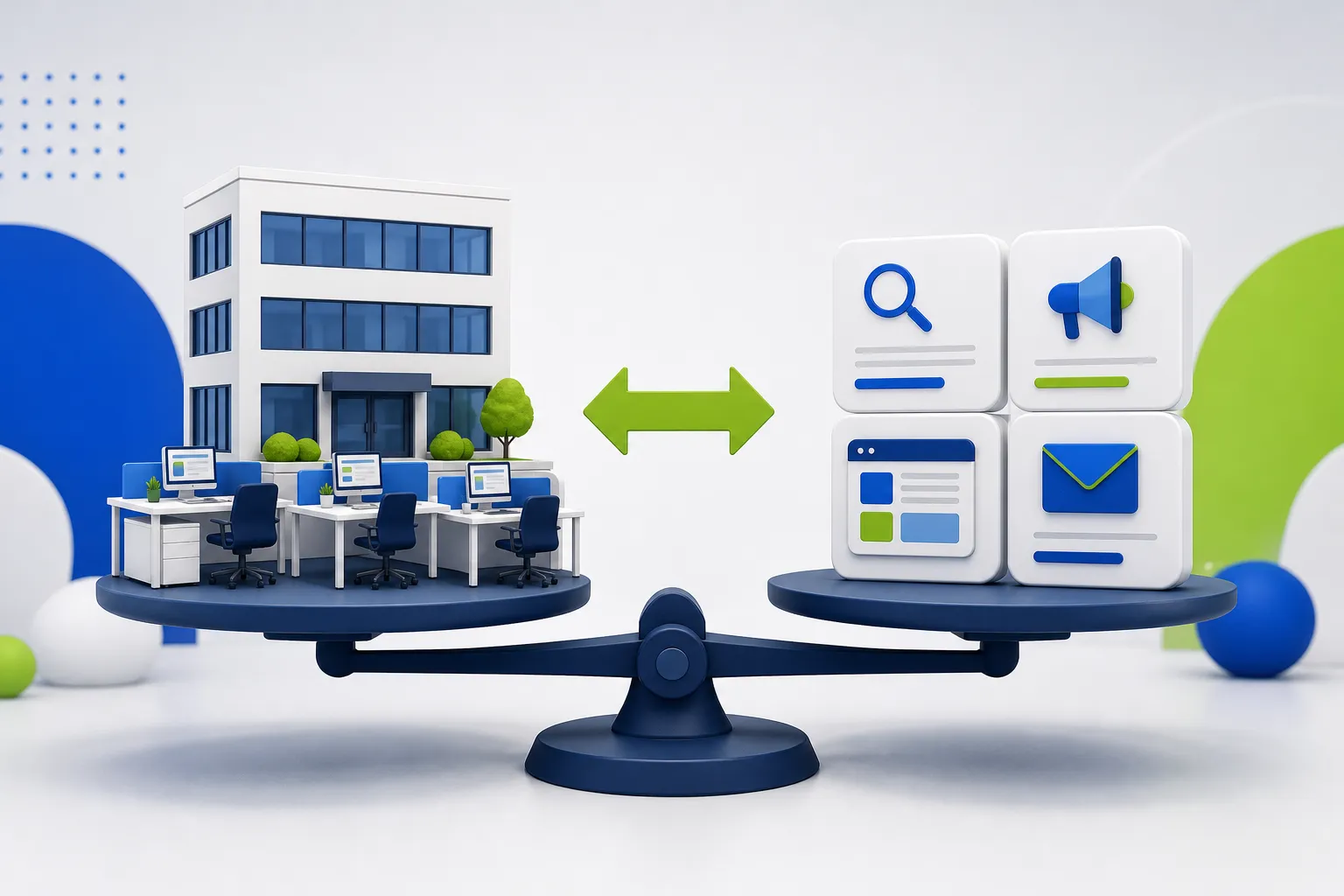
Neither option is better in every case. The right choice depends on how much marketing work you have, how many different skills it takes, and how much time you can spend managing it. This guide compares the two side by side, explains the costs you’re actually weighing, and shows when each one makes sense. If you’re leaning toward an agency, our list of questions to ask a marketing agency will help you vet one.
What In-House Marketing Means
In-house marketing means your marketing is done by your own employees. For a small local business that’s often one person: a marketing coordinator or manager who handles social media, the website, email, reviews and sometimes the ads. Larger businesses may have a small team with separate roles.
The big advantage is focus. An in-house marketer knows your services, your staff and your customers, sits in on meetings, and can react the same day. The trade-off is range. Modern local marketing includes SEO, local SEO and the Google Business Profile, paid search, paid social, web design, tracking and analytics. It’s rare for one person to be strong at all of them.
What a Marketing Agency Does
A marketing agency is an outside company you hire to plan and run some or all of your marketing. Agencies range from specialists that only do SEO or only run ads to full-service firms that cover most channels. You can see the range of work we handle on our services page, and our guide to what an SEO agency does explains the day-to-day work behind search.
The advantage is breadth. You get access to people who each focus on one discipline, plus the paid tools they use for keyword research, rank tracking, call tracking and reporting. The trade-off is that an agency serves several clients, so it won’t know your business as closely as an employee unless you keep it informed.
Marketing Agency vs In-House: Side-by-Side Comparison
| Factor | In-house team | Marketing agency |
|---|---|---|
| How you pay | Salary, benefits and payroll costs | A monthly retainer, project fee, or setup fee plus monthly |
| Range of skills | Limited to the people you hire | A team of specialists across channels |
| Knowledge of your business | Deep and day to day | Depends on how well you communicate |
| Tools and software | You buy and learn them | Usually included in the agency’s work |
| Time to get started | Recruiting, hiring and training | Usually weeks, after onboarding |
| Your management time | You manage the person | You manage the relationship |
| Scaling up or down | Hiring or letting people go | Change the scope of work |
| If someone leaves | Knowledge can walk out the door | The agency covers the gap |
| Responsiveness | Same day, on site | Depends on the agency’s process |
Cost: What You’re Actually Comparing
It’s easy to compare a salary with an agency fee and stop there. That leaves out most of the real cost on both sides. We don’t quote prices here, because any number without your market and goals is a guess, but these are the factors to put in your comparison.
The cost of an in-house marketer
- Salary, which depends on experience, role and your local job market.
- Benefits, payroll taxes and paid time off.
- Recruiting and training, including the months before a new hire is fully up to speed.
- Software subscriptions for SEO research, rank tracking, call tracking, design, scheduling and reporting. Many of these are priced per user or per location.
- Your time managing and reviewing the work.
- Outside help for skills the person doesn’t have, such as web development or ad management.
The cost of an agency
- The fee, which depends on how many services, locations and channels are involved, how competitive your market is, and how much work your website needs.
- The structure: monthly retainer, one-time project, or a setup fee followed by a monthly fee.
- Your time giving feedback, approving work and sharing information.
- Contract terms, such as how long you’re committed and what it costs to leave.
Ad spend is separate either way
If you run Google Ads or Meta ads, the money you spend on ads goes to the platform no matter who manages the campaigns. With an agency, the management fee is a separate cost. Keep the two apart when you compare options. Our guide to Google Ads cost explains the split, and our post on how much small businesses should spend on digital marketing covers budgeting.
When In-House Marketing Makes Sense
- You have a steady, high volume of day-to-day work, such as social posts, events, email, photos and customer communication.
- Your marketing depends on being on site: photographing jobs, filming staff, or working closely with sales.
- You can afford more than one hire, or you only need one or two skills done well.
- You have someone in the business with the time and know-how to manage a marketer.
When an Agency Makes Sense
- You need several specialized skills, such as SEO, Google Ads and web design, but not enough work in each to justify a full-time hire.
- You want results without first building a team, buying tools and training people.
- You’ve had in-house marketers leave and take the know-how with them.
- You compete in a crowded local market where small technical details, like technical SEO or Google Ads settings, make a real difference.
- You need help with a defined project, such as a new website, a launch or a redesign, and don’t need a permanent role for it.
The Hybrid Model: In-House Plus Agency
For many local businesses the answer is both. A common setup is an in-house person who owns the brand, social media, photos, reviews and customer communication, while an agency handles the specialized work: search, paid ads, the website and tracking.
This works well when the roles are clear. Decide who owns which channel, who approves what, and where reports go. The in-house person feeds the agency what it can’t see from outside, such as which jobs are most profitable, new services, seasonal changes and what customers say on the phone. The agency feeds back data on which channels bring calls and leads.
Who usually does what in a hybrid setup
| Work | Often in-house | Often agency |
|---|---|---|
| Social media posts and community | Yes | Sometimes |
| Photos and video of real jobs | Yes | Sometimes |
| Review requests and replies | Yes | Supports the process |
| SEO and local SEO | Rarely | Yes |
| Google Ads and Meta ads | Rarely | Yes |
| Website design and fixes | Rarely | Yes |
| Call tracking and reporting | Reviews the numbers | Sets up and reports |
Common Mistakes When Deciding
- Expecting one hire to be an expert in everything. A great social media marketer may not know Google Ads, and that’s normal.
- Hiring an agency and then going quiet. An agency can’t market a business it doesn’t understand. Plan regular check-ins.
- Not tracking leads. Whichever route you choose, you need to know which calls and forms came from which channel. Otherwise you’re comparing on gut feel. Our guide to measuring digital marketing ROI walks through the setup.
- Letting someone else own your accounts. Whether it’s an employee or an agency, your domain, website, ad accounts and analytics should be in your business’s name.
- Rebuilding your website without a plan. A new marketer or agency often wants a new site. Make sure it won’t cost you your rankings. See our guide to redesigning a website without losing SEO.
A Simple Way to Decide
Write down the marketing work you need over the next year and the skills each piece takes. Mark which pieces need someone on site and which need specialist knowledge. If most of the list is day-to-day and on site, start in-house. If most of it is specialized, start with an agency. If it’s a mix, plan for both, and decide who owns what before anyone starts.
How Local Blitz Works With Businesses and In-House Teams
We’ve worked with local businesses since 2009, from offices in San Diego (Encinitas) and Indianapolis. Some clients hand us all their marketing. Others have an in-house person and use us for SEO, ads, web design or tracking. We don’t sell cookie-cutter packages, and we work on a monthly retainer, a one-time project, or a setup fee plus monthly, depending on the work. Ad spend is paid separately to the platform, contracts are month-to-month, and our reports cover calls, leads and rankings. Our process page shows how an engagement runs.
Frequently Asked Questions
Is it cheaper to hire a marketing agency or an in-house marketer?
It depends on how much work you have and how many skills it takes. One in-house hire costs salary, benefits, recruiting, training, software and management time. An agency costs a fee that depends on scope, market and channels. For businesses that need several specialized skills but not full-time work in each, an agency often covers more ground for the money.
Can I use a marketing agency and an in-house team together?
Yes, and many local businesses do. A common split is an in-house person handling social media, photos, reviews and customer communication, while an agency runs SEO, paid ads, the website and tracking. It works best when you decide up front who owns each channel and how results are reported.
What are the disadvantages of a marketing agency?
An agency works for several clients, so it won’t know your business as closely as an employee unless you keep it informed. You also depend on its process for response times. Clear communication, regular check-ins and accounts held in your own name reduce those risks.
What are the disadvantages of in-house marketing?
The main drawbacks are limited skills, since one or two people rarely cover SEO, ads, web design and analytics well, plus the cost and time of hiring, training and buying tools. Knowledge can also leave the business when an employee moves on.
Is ad spend included when comparing agency and in-house costs?
No. Ad spend goes to Google, Meta or another platform whichever option you choose. With an agency, the management fee is a separate cost from ad spend, so compare the cost of managing campaigns, not the total amount spent on ads.
Not Sure Which Route Fits Your Business?
Book a free strategy call and we’ll look at your current marketing, the work you need done, and whether an agency, an in-house hire or a mix makes the most sense. If it’s not us, we’ll say so.
Is AI recommending your business?
We will ask ChatGPT, Gemini and Google AI about your business and show you what they say. It is free.
Want More Customers From Search?
Book a free strategy call, or call San Diego (858) 225-6877 or Indianapolis (317) 672-1156.