
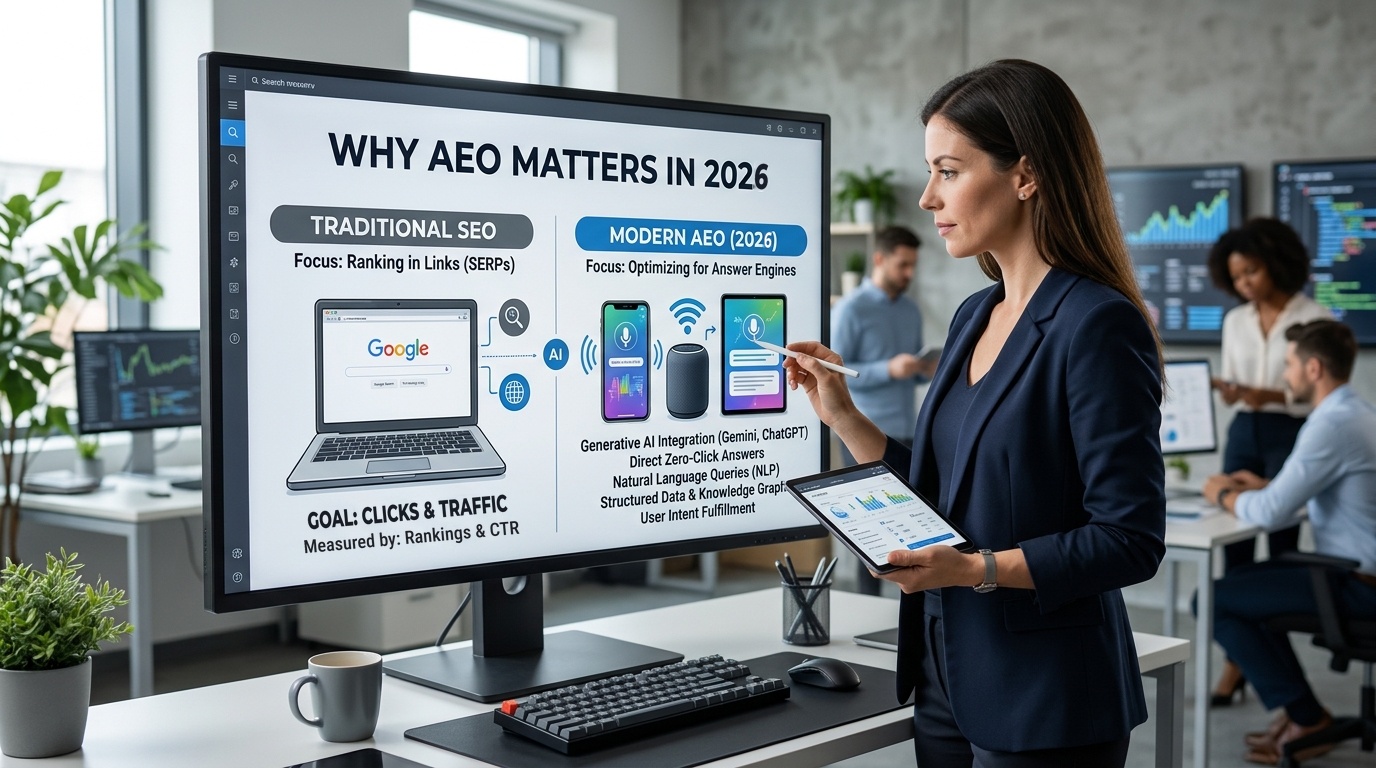
Why AEO Matters in 2026
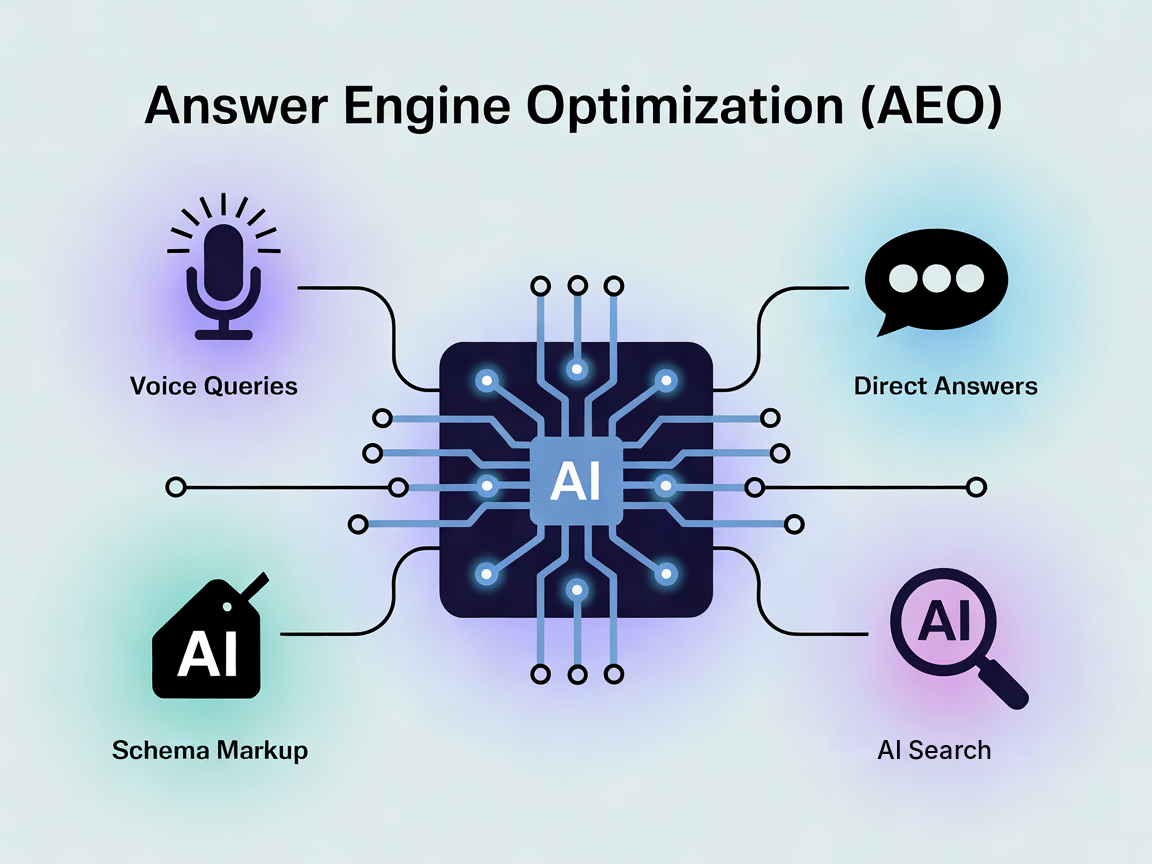
Key Characteristics of Answer Engine Optimization
-
- Structured data: Schema markup tells machines what a page is about, not just which words it contains. Organization, Article, Product, and FAQPage markup help AI systems identify who you are and which parts of the page answer which questions.
-
- Conversational phrasing: Headings and answers mirror how people actually ask questions. “How long does a roof replacement take?” works better than a fragment like “Roof Replacement Timeline.”
-
- Topic coverage over exact keywords: AEO content addresses the full intent behind a question. A page on running shoes for flat feet should also cover arch support and overpronation, because those are the follow-up questions people ask.
-
- Easy-to-extract formatting: Clear headings, short paragraphs, lists, and tables let AI models pull out facts without guessing what a dense paragraph means.
-
- Trust signals: Named sources, dated statistics, and clear authorship make your content a safer choice for an AI tool to cite.
How Does Answer Engine Optimization Work?
AEO rests on five connected practices:-
- Answer-first structure. Each section opens with a heading phrased the way people ask, followed immediately by a clear answer. A heading like “What is AEO?” is easy for an AI model to match to a user’s question.
-
- Structured data. Developers add JSON-LD schema so search engines like Google and Bing can correctly identify the business, products, and content on each page.
-
- Snippet-ready answers. Short, direct answers (roughly 40–60 words) placed right under a heading are well suited to both featured snippets and AI summaries.
-
- Plain, precise language. Complete sentences, defined terms, and specific nouns are easier for language models to interpret than idioms, vague pronouns, or clever wordplay.
-
- Visibility across platforms. Google, Bing, ChatGPT, and Perplexity each find and select sources differently, so content needs to be crawlable and clear for all of them, not just Google.
Common Misconceptions About AEO
| Myth | Reality |
|---|---|
| AEO replaces SEO | AEO depends on SEO. If a page can’t be crawled or indexed, AI tools can’t use it either. |
| AEO is only about voice search | It covers AI chatbots, AI Overviews, AI Mode, and zero-click results, not just voice assistants. |
| Keyword research no longer matters | Research is still how you find the questions your audience asks and the intent behind them. |
| Schema markup guarantees AI citations | Schema makes content easier for machines to read, but it doesn’t force any tool to cite you. |
| AEO only works for big brands | Smaller sites can earn citations, especially on specific local or niche questions where they are the clearest source. |
| Results show up right after publishing | AI search tools re-check sources on their own schedules. Most teams see changes over weeks or months, not days. |
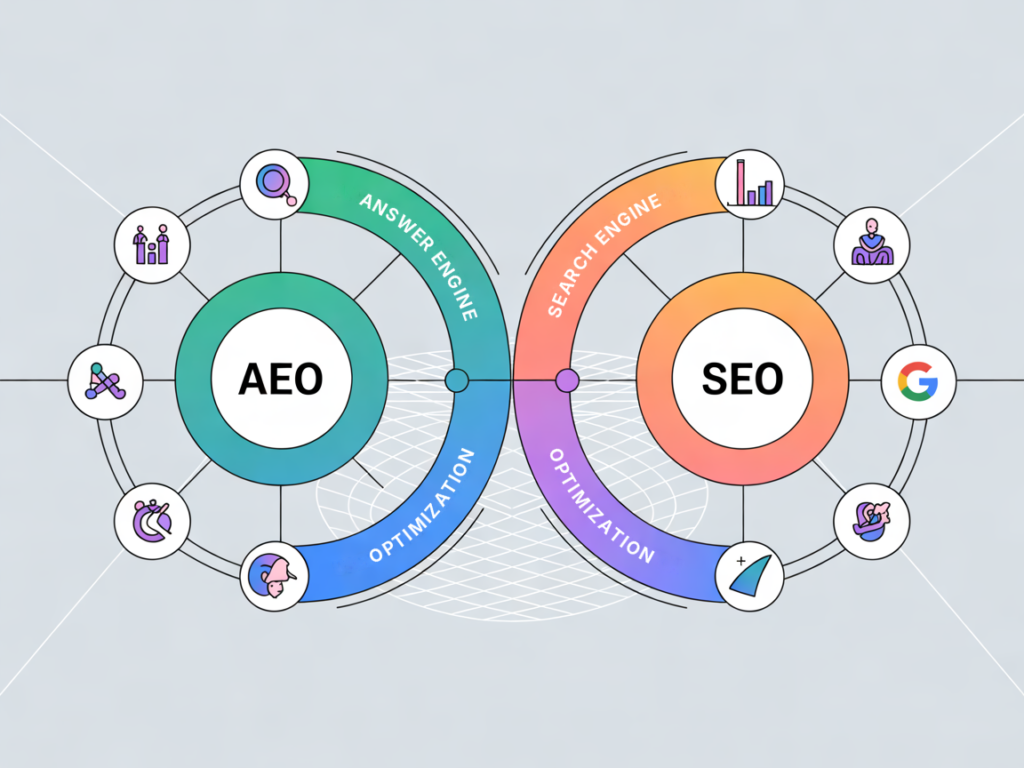
AEO vs. SEO: Side-by-Side Comparison
| Factor | SEO | AEO |
|---|---|---|
| Main goal | Rank high in search results | Be cited inside AI-generated answers |
| Key platforms | Google, Bing | ChatGPT, Perplexity, Google AI Overviews and AI Mode, Copilot, Gemini |
| Success metrics | Rankings, clicks, click-through rate | Citations, brand mentions, answer inclusion |
| Content style | In-depth pages built around target keywords | Clear, direct answers organized around questions |
| Core methods | Backlinks, technical SEO, on-page optimization | Structured data, topic coverage, answer-first writing |
| User behavior | Clicks through to a website | Often gets the answer without clicking |
| Measurement tools | Google Search Console, rank trackers | Prompt testing, AI visibility tools, Search Console’s generative AI report, Bing’s AI Performance report |
| Update frequency | Refreshed when rankings slip | Refreshed regularly to stay current and accurate |
Practical Applications of AEO
1. Writing for AI Chatbots
Give the answer in the first one or two sentences, then add supporting detail. For example, a returns page should open with something like “We accept returns within 30 days with a receipt” and then cover the exceptions. If the answer is buried in the third paragraph, an AI tool may skip it or pull the wrong detail.2. Optimizing for Voice Search
Spoken questions are longer and more natural than typed ones. Someone might type “best pizza NYC” but ask a voice assistant, “What’s the best pizza place open near me right now?” Pages that answer the full spoken version of a question are better positioned for voice results.3. Targeting Featured Snippets
Featured snippets and AI summaries reward the same habit: a short, direct answer right below a question-style heading. Keeping that answer under about 50 words improves your chances of being pulled into both.4. Adding Structured Data
Start with Organization schema on your homepage, then add Article, Product, or LocalBusiness markup where it fits. Google stopped showing FAQ rich results in 2026, but FAQPage is still valid markup. Keep it on pages with genuine question-and-answer content, where it helps machines understand your answers.How to Prepare Your Website for Answer Engines
-
- Audit your content. Flag pages where the main answer sits far down the page or is never stated clearly.
-
- Add structured data to your most important pages first, starting with high-traffic articles and service or product pages.
-
- Rewrite introductions so they answer the core question within the first two sentences.
-
- Mine Search Console for questions. Filter the Performance report for queries that start with “how,” “what,” “why,” or “best” to find questions people already use to reach you. Then check the generative AI report to see which pages appear in AI Overviews and AI Mode.
-
- Test AI platforms directly. Ask ChatGPT, Perplexity, Gemini, and Google your target questions, and record whether your business is mentioned or linked.
The Future of Search: Where AEO and SEO Are Heading
Search engines and AI assistants are becoming harder to tell apart. Google’s AI Mode and Microsoft Copilot now combine traditional results with conversational answers, which points toward the two approaches merging rather than one replacing the other. AI tools also tend to return to sources they already trust, so businesses that build a track record of clear, accurate answers now may find that advantage grows over time. The safest plan is to treat AEO and SEO as one strategy, not two competing ones.Key Takeaways
-
- AEO means structuring content so AI tools can find, trust, and cite it as a direct answer.
-
- SEO is still the foundation; AEO builds on it rather than replacing it.
-
- Structured data, answer-first writing, and full topic coverage are the core AEO techniques.
-
- Rising zero-click searches and AI-generated answers are why AEO matters in 2026.
-
- The best results come from combining strong technical SEO with content written for AI extraction.
Frequently Asked Questions
What is the difference between AEO and SEO?
SEO focuses on ranking pages high in search results so people click through to your site. AEO focuses on getting your content quoted or cited inside AI-generated answers from tools like ChatGPT, Perplexity, and Google AI Overviews. SEO builds the foundation, and AEO makes that content easier for AI tools to use.Does AEO replace SEO?
No. AEO depends on SEO. AI search tools often pull from the same indexes as traditional search engines, so a page that can’t be crawled or indexed won’t appear in AI answers either. The strongest approach treats AEO and SEO as one strategy.How long does AEO take to show results?
Most businesses should expect changes over one to three months of consistent updates, not days. AI search tools re-check sources on their own schedules, so a single optimized page rarely changes your visibility overnight.Is schema markup still useful for AEO?
Yes. Schema markup helps AI systems understand who you are and what your pages cover. Google no longer shows FAQ rich results, but FAQPage is still valid markup, and Organization, Article, Product, and LocalBusiness schema remain useful. Schema improves readability for machines but does not guarantee citations.How can I check if my business appears in AI answers?
Ask ChatGPT, Perplexity, Gemini, and Google your target questions and record whether your business is mentioned or linked. You can also review Google Search Console’s generative AI report and Bing Webmaster Tools’ AI Performance report, or use a dedicated AI visibility tool for ongoing tracking.Is AI recommending your business?
We will ask ChatGPT, Gemini and Google AI about your business and show you what they say. It is free.
Want More Customers From Search?
Book a free strategy call, or call San Diego (858) 225-6877 or Indianapolis (317) 672-1156.