
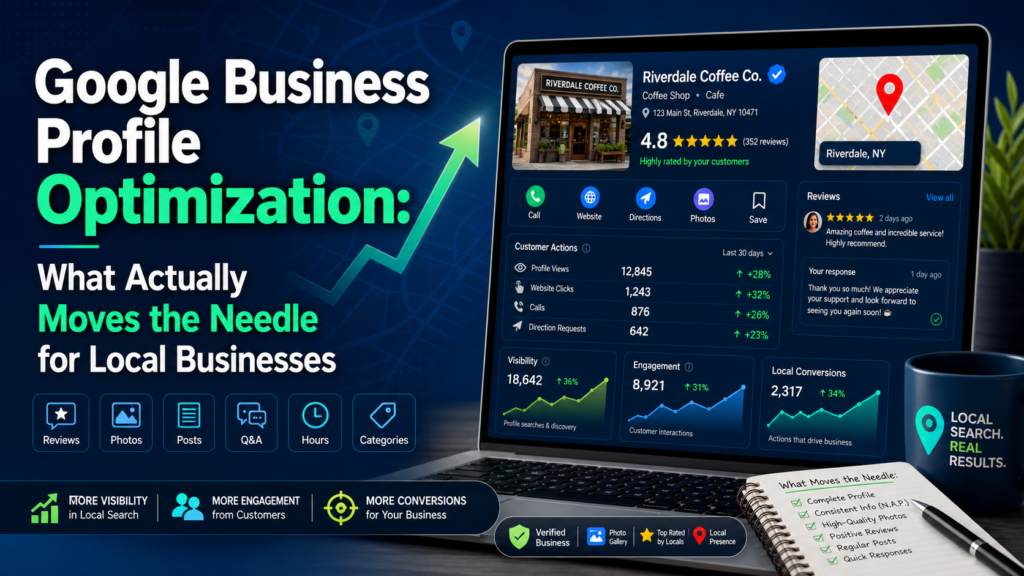
Google Business Profile optimization is the strategic process of enhancing and managing a business's Google listing to improve visibility in Google Maps, Google Search, and the Local Pack for location-based queries. As of 2025, this practice remains the most direct method for local businesses to influence how they appear when potential customers search for nearby services or products.
Formerly known as Google My Business (GMB), Google Business Profile serves as the central hub for how businesses present themselves across Google's ecosystem. The optimization process encompasses everything from accurate NAP citations (Name, Address, Phone number) to customer review management and strategic content deployment through Google Posts.
Why Google Business Profile Management Matters for Local Business Growth

According to Google's 2024 data, 76% of consumers who conduct a nearby business search visit a physical location within 24 hours. This geographic search optimization opportunity makes business profile management essential for local customer acquisition. Businesses with complete and optimized profiles receive 7 times more website visits and 3 times more direction requests compared to incomplete listings.
The local search algorithm evaluates three primary local ranking factors: proximity (physical distance to searcher), relevance (how well the business matches search intent), and prominence (overall authority and visibility of the business). Unlike traditional organic rankings, these location-based marketing signals operate on different weighting, making local SEO optimization a distinct discipline requiring specialized strategies.
Five Key Characteristics of Effective Google Business Profile Optimization
1. Complete Business Information Optimization
Business profile completeness signals trustworthiness to Google's local search algorithm. This includes accurate business categories, comprehensive business description (750 characters optimized with relevant keywords), verified business hours including special hours for holidays, and properly configured service area for businesses without physical storefronts.
2. Strategic Visual Content Management
Google business photos generate 42% more direction requests and 35% more website clicks than profiles without images. Optimal profiles include exterior and interior photos, team photos, product images, and where applicable, 360 photos or virtual tours. The platform prioritizes recent uploads, making regular photo updates part of effective GMB performance strategies.
3. Active Customer Review Strategy
Review velocity (the rate of new review acquisition) and review response consistency directly impact local pack rankings. Businesses averaging 5 or more reviews per month show significantly stronger map pack visibility than competitors with sporadic review patterns. Star ratings influence click-through rate, while thoughtful review responses demonstrate local business credibility and customer engagement.
4. Regular Content Updates Through Google Posts
Google Posts function as micro-content opportunities appearing directly in your Business Profile. Posts expire after 7 days (event posts after the event date), requiring consistent publication schedules. Businesses posting weekly maintain 22% higher engagement metrics than those posting sporadically.
5. Accurate Business Attributes Selection
Business attributes communicate specific features like “wheelchair accessible,” “free Wi-Fi,” or “outdoor seating.” These attributes appear as searchable filters in Google Maps, making them critical for local discovery when users refine searches by specific amenities or services.
How Google Business Profile Optimization Works: The Ranking Signal Framework
Step 1: Google Business Verification and Setup
The GMB verification process establishes ownership and authenticity. Verification methods include postcard verification (5-14 days), phone verification, email verification, or instant verification for eligible businesses. Until verified, profiles have limited functionality and diminished local search visibility.
Step 2: Primary and Secondary Categories Configuration
The primary category exerts the strongest influence on what searches trigger your listing. According to 2024 local SEO research, primary category selection alone accounts for approximately 15-20% of ranking weight in proximity search results. Secondary categories broaden relevance without diluting primary focus. Service-based businesses should select categories reflecting customer search language rather than internal business structure.
Step 3: NAP Consistency and Local Citation Building
NAP consistency across business listings, directory listings, and local citations reinforces geographic relevance. Inconsistent information (variations in business name, old addresses, multiple phone numbers) creates ranking confusion and suppresses local pack optimization efforts. Platforms like LocalBlitz help businesses maintain citation accuracy across hundreds of directories simultaneously.
Step 4: Schema Markup Implementation
Local Business Schema on your website creates structured data that Google can match with your Business Profile. This schema markup includes business name, address, phone, hours, and accepted payment methods—creating verification loops that strengthen local search performance.
Step 5: Performance Monitoring via Google Insights
Google Insights provides performance metrics including impressions (discovery and direct searches), website visits, direction requests, and phone calls. These local search metrics reveal which optimization strategies drive actual customer actions versus vanity metrics that don't translate to local conversion optimization.
Common Misconceptions: Myth vs. Reality in Local Business SEO
Myth 1: Keyword Stuffing Business Names Improves Rankings
Reality: Google's guidelines explicitly prohibit adding keywords to business names (e.g., “Joe's Plumbing | Best Emergency Plumber Dallas”). Violations risk suspension. Instead, leverage the business description, services section, and Google Posts for keyword integration.
Myth 2: More Categories Always Mean Better Visibility
Reality: According to 2024 Google business strategy research, profiles with 1 primary + 2-4 relevant secondary categories outperform those with maximum category stuffing. Over-categorization dilutes relevance signals and triggers appearing for irrelevant searches, harming click-through rate.
Myth 3: Reviews Only Matter for Reputation
Reality: Review velocity, sentiment, and keyword content within reviews all function as ranking signals. Reviews mentioning specific services or locations strengthen relevance for those search terms. A business with 50 reviews mentioning “emergency plumbing” will likely rank stronger for that phrase than a competitor with 100 generic reviews.
Myth 4: Optimization Is a One-Time Task
Reality: The local search algorithm favors active, engaged profiles. Regular updates through Google business posts, photo uploads, service additions, and Q&A responses signal ongoing business operation and customer focus—factors that influence prominence scores.
Google Business Profile vs. Traditional SEO: Understanding the Distinction

| Factor | Google Business Profile | Traditional Organic SEO |
|---|---|---|
| Primary Ranking Signals | Proximity, relevance, prominence, reviews, engagement | Backlinks, content quality, technical optimization, domain authority |
| Geographic Influence | Physical location dominates (accounts for 40-50% of ranking weight) | Geographic signals minimal unless location-specific content |
| Speed of Results | Changes visible in 24-72 hours; full impact 2-4 weeks | Significant changes require 3-6 months minimum |
| Control Level | Direct control over most ranking factors | Limited control; dependent on external backlinks and authority |
| Click Destinations | Calls, directions, messages, website (diverted traffic) | Website visits (concentrated traffic) |
This distinction matters because many businesses mistakenly apply traditional SEO tactics to local optimization or vice versa. Google Maps optimization requires different GMB optimization techniques than improving organic website rankings.
Practical Applications: Strategic Optimization by Business Type
Google Business Profile Optimization for Service Area Businesses
Plumbers, electricians, and contractors face unique challenges because they serve customers at various locations rather than a fixed storefront. Service area optimization requires hiding the business address while defining service regions. Best practices include creating service pages on your website matching Google Business Profile service listings and using city names in your business description without violating naming guidelines.
Google Business Profile Optimization for Multi-Location Businesses
Businesses with multiple locations must create separate profiles for each location, maintaining unique photos, posts, and business descriptions per location. According to 2024 multi-location research, franchises that empower individual locations to customize content see 31% higher engagement than those using identical corporate content across all locations.
Google Business Profile Optimization for Restaurants
Restaurants benefit from adding menus through the Products feature, selecting attributes like “outdoor seating” or “vegan options,” and posting weekly about specials or events. Food photos should be updated seasonally, and restaurant hours must reflect actual service times (not just building access) to avoid customer frustration.
Industry-Specific Strategies
- Google Business Profile optimization for dentists: Emphasize attributes like “accepts new patients,” showcase before/after photos (with patient consent), list specific services (teeth whitening, implants)
- Google Business Profile optimization for lawyers: Select practice area categories carefully, respond professionally to all reviews, use Q&A to address common legal questions
- Google Business Profile optimization for real estate agents: Regularly update listings with recent sales, use posts to showcase properties, include neighborhood expertise in description
Measuring Success: Essential Google Business Profile Metrics
Effective GMB insights analysis tracks four core performance categories:
- Discovery Impressions: How many users found your profile through searches (direct name searches vs. discovery through category/service searches)
- Action Metrics: Website clicks, direction requests, phone calls initiated through your profile
- Engagement Indicators: Photo views, post clicks, Q&A interactions
- Competitive Positioning: How your metrics compare to similar businesses in your geographic area
According to 2025 benchmarks, well-optimized profiles in competitive markets average 1,200-3,000 monthly impressions with 3-7% conversion to actions (calls, directions, website visits). Service businesses typically see higher direction request percentages, while professional services generate more website visits and calls.
The Bottom Line: What Actually Moves the Needle
After analyzing hundreds of local business profiles, three factors consistently demonstrate the strongest correlation with improved local pack rankings and customer acquisition:
First, consistent review generation (minimum 3-5 reviews monthly) with response rates above 75% signals active customer engagement and business quality. Second, accurate, comprehensive business information—particularly primary category selection and complete service listings—ensures relevance for high-intent searches. Third, regular activity through posts, photos, and Q&A responses maintains algorithmic favor and demonstrates ongoing business operation.
The businesses winning local search visibility in 2025 treat Google Business Profile as an active marketing channel requiring weekly attention rather than a passive directory listing requiring annual updates. This shift from static listing to dynamic local presence optimization separates businesses capturing customer attention from those remaining invisible in increasingly competitive local search results.