
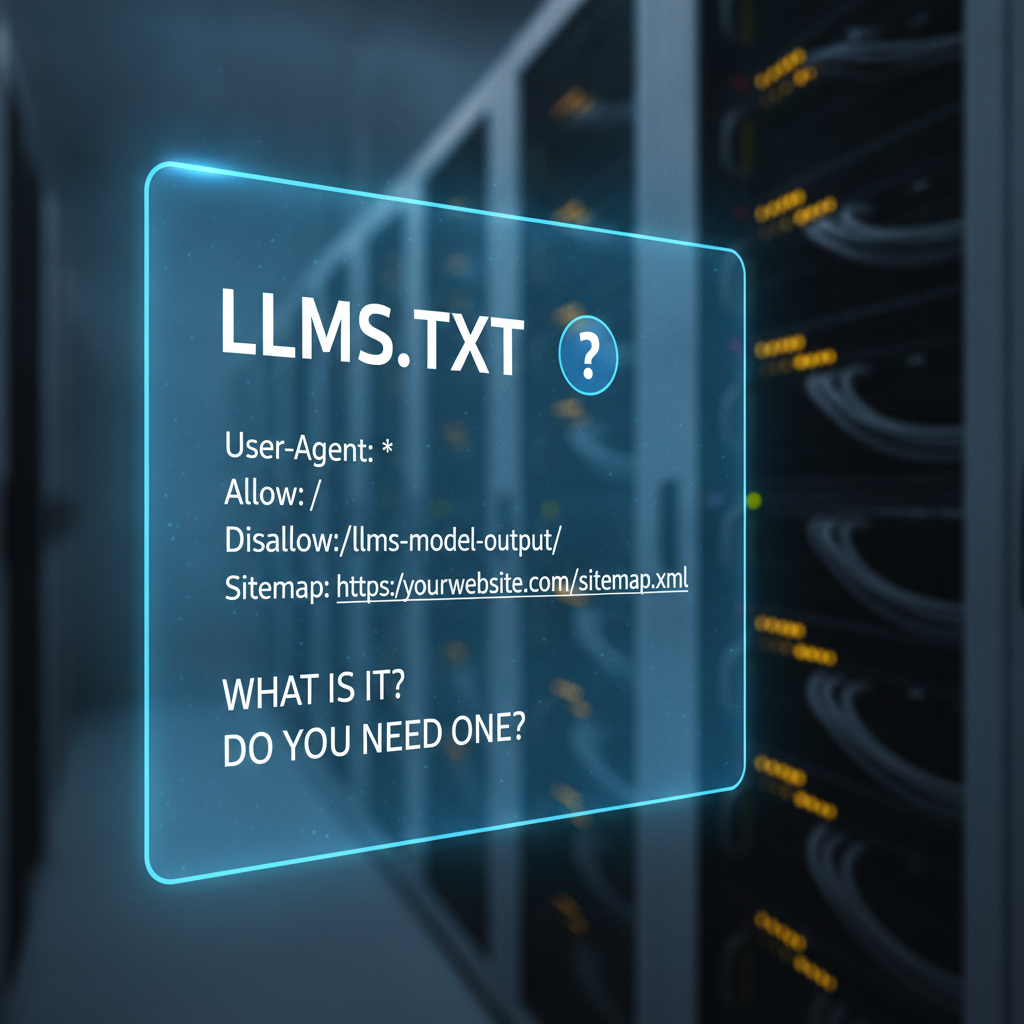
An llms.txt file is a plain text file that instructs Large Language Models and AI crawlers how to interact with your website content. This step-by-step guide teaches webmasters and site administrators how to create, implement, and optimize an llms.txt file in under 30 minutes, regardless of technical skill level.
Before You Begin
- Access to your website's root directory via FTP, cPanel, or content management system
- Basic understanding of file formats (HTML, XML, JSON, or plain text file)
- Familiarity with your web server configuration (Apache htaccess file or nginx configuration)
- Knowledge of existing bot management files (robots.txt, sitemap.xml)
- Approximately 20-30 minutes to complete implementation
What Is an llms.txt File and How Does It Work?

An llms.txt file serves as a bot instruction file specifically designed for AI model training and language model optimization (Anthropic, 2024). Unlike robots.txt, which controls all web crawlers, llms.txt provides AI-specific metadata and content licensing for AI systems including ChatGPT, Claude, and Gemini. The file uses machine-readable content formats to communicate website AI permissions and automated content extraction rules to GPTBot, Googlebot, and other AI bots.
According to OpenAI's 2024 documentation, LLM data sources increasingly rely on structured data for LLMs to improve content discovery and AI training data quality. The llms.txt file format enables website AI compatibility by specifying bot access rules, crawl rate settings, and content availability for LLMs.
Step 1: Determine If Your Website Needs an llms.txt File

Evaluate whether implementing llms.txt for websites aligns with your content strategy by answering these questions:
- Content Protection Requirements: Does your website contain proprietary information requiring AI scraping permissions or content licensing restrictions?
- AI Training Dataset Control: Do you want to manage how AI models use your content for machine learning data sources?
- Bandwidth Optimization: Are AI crawlers consuming excessive crawl budget or server resources?
- Legal Compliance: Do copyright or content licensing for AI regulations require documented bot behavior specification?
Websites that benefit most from llms.txt implementation include e-commerce platforms, news websites, blog websites with original research, and sites with high-value intellectual property. According to Google's 2024 machine learning compliance guidelines, websites generating over 10,000 monthly pageviews should implement AI crawler management protocols.
Step 2: Create the llms.txt File Structure and Syntax
Generate your llms.txt file using this standardized format for AI content discovery:
llms.txt – AI Bot Management File
Last Updated: 2025-01-15
User-agent: GPTBot
Allow: /blog/
Allow: /resources/
Disallow: /private/
Crawl-delay: 10

User-agent: Google-Extended
Allow: /
Disallow: /admin/
Crawl-delay: 5

User-agent: Claude-Web
Allow: /public-content/
Disallow: /user-data/
Content Licensing
License: CC-BY-4.0
Attribution-Required: true
The llms.txt file syntax follows these automated indexing rules:
- User-agent: Specifies the AI bot configuration (ChatGPT crawlers, Google AI bots, Anthropic crawlers)
- Allow rule: Permits access to specific directories for neural network training
- Disallow rule: Blocks automated data harvesting from protected areas
- Crawl-delay: Sets intervals between requests for bandwidth optimization
- Comment syntax: Lines beginning with # provide documentation
Step 3: Configure Advanced AI Crawler Instructions
Implement these website AI optimization techniques for intelligent bot management:
Access Control Configuration
Define permission management using allow and disallow directives similar to robots meta tag and noindex directive protocols. Specify wildcard usage for directory-level control:
User-agent: *
Disallow: /wp-admin/
Disallow: /cgi-bin/
Allow: /wp-content/uploads/
Content Discovery Protocol Settings
Include structured data references using JSON-LD, schema markup, or microdata formats. Link to your sitemap protocol and RSS feed for comprehensive AI indexing protocol:
Sitemap: https://example.com/sitemap.xml
Feed: https://example.com/feed.atom
Schema: https://example.com/schema.json
Step 4: Upload and Validate Your llms.txt File
Follow these steps for proper llms.txt file implementation:
- File Placement: Upload llms.txt to your website's root directory (example.com/llms.txt), similar to robots.txt, sitemap.xml, humans.txt, and security.txt placement
- Encoding Standards: Save using UTF-8 encoding without BOM (Byte Order Mark)
- Line Break Handling: Use Unix-style line breaks (LF) rather than Windows (CRLF)
- Character Limits: Keep individual lines under 500 characters for optimal parsing
- HTTP Response Codes: Verify the file returns 200 OK status, not 404 error or 301 redirect
Testing and Validation Methods
Validate your implementation using these llms.txt file validation methods:
- Check HTTP protocol response using curl or wget commands
- Verify HTTP headers include correct Content-Type: text/plain
- Test with URL inspection tools similar to fetch as Google or render testing utilities
- Confirm file accessibility via CDN and caching systems
- Monitor web server logs for AI bot user agent requests
Step 5: Monitor and Maintain Your llms.txt File
Implement ongoing llms.txt file monitoring and maintenance using these practices:
- Update Frequency: Review quarterly or when launching new content sections
- Error Checking Tools: Monitor for 500 error responses or server directives conflicts
- Crawl Budget Analysis: Track AI bot activity in server logs to optimize crawl delay settings
- Compliance Audits: Verify alignment with content licensing for AI and copyright requirements
According to 2024 website AI readiness standards, sites should log AI crawler activity separately from traditional Bingbot and search engine traffic to measure LLM compatibility and generative AI access patterns.
Troubleshooting Common llms.txt File Issues
If AI crawlers ignore your llms.txt file:
- Problem: File returns 404 error → Solution: Verify placement in root directory, not subdirectories
- Problem: Syntax errors prevent parsing → Solution: Use llms.txt file error checking tools to validate format
- Problem: Rules conflict with robots.txt → Solution: Ensure consistent directives between bot exclusion protocol files
- Problem: Excessive server load persists → Solution: Increase crawl-delay values and implement rate limiting via nginx configuration
- Problem: Content still appears in AI responses → Solution: Add noindex directive and robots meta tag to HTML pages
Next Steps: Advanced Website AI Optimization
Enhance your AI content filtering and language model guidelines with these techniques:
- Implement canonical URL tags and Open Graph protocol for content deduplication
- Add schema markup and JSON-LD structured data for improved machine learning crawlers comprehension
- Configure well-known directory files (ads.txt, app-ads.txt, sellers.json) for comprehensive bot communication standard
- Optimize Core Web Vitals, page speed, and lazy loading for mobile-first indexing compatibility
- Set up content delivery network (CDN) caching and compression for efficient AI data collection policy enforcement
- Monitor indexation and deindexing patterns using webmaster tools
The llms.txt specification continues evolving as OpenAI, Google, and Anthropic refine their AI web scraping protocols. Regular updates ensure your website maintains optimal AI-friendly website status while protecting valuable content from unauthorized automated content extraction.