
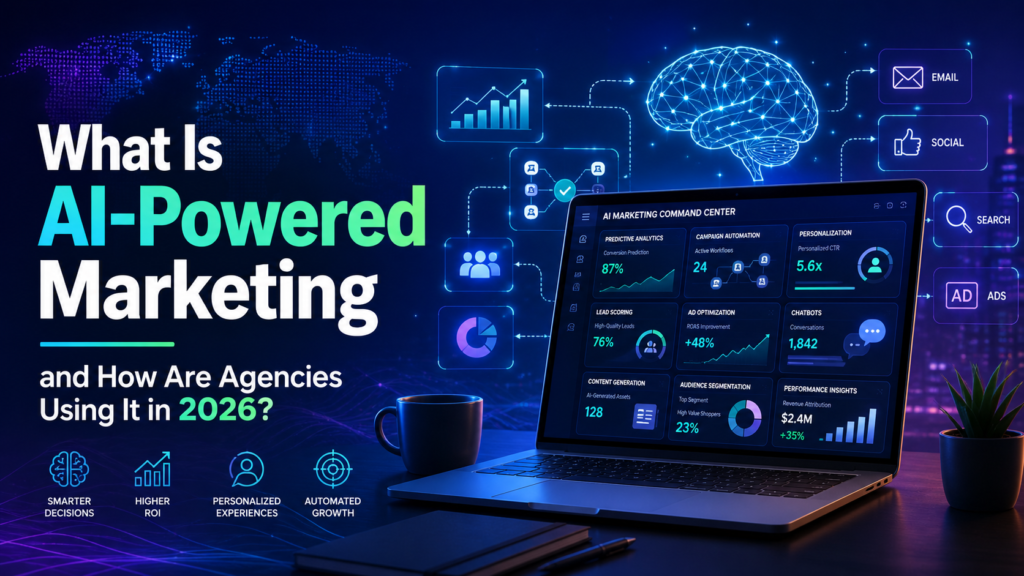
AI-powered marketing is the application of Artificial Intelligence, Machine Learning, and predictive analytics to automate, optimize, and personalize marketing campaigns through data-driven insights and intelligent decision-making systems. As of 2026, Marketing Agencies worldwide leverage these technologies to deliver superior campaign performance, enhanced customer experiences, and measurable business outcomes at unprecedented scale.
Why AI-Powered Marketing Matters for Agencies in 2026

According to marketing industry research from 2025, agencies implementing artificial intelligence marketing strategies report 37% higher customer engagement rates and 42% improved marketing ROI compared to traditional approaches. The convergence of Big Data, Cloud Computing, and advanced Neural Networks has transformed how Marketing Agencies operate, enabling intelligent marketing solutions that were impossible just five years ago.
The shift toward AI-driven campaigns reflects fundamental changes in consumer expectations. Modern customers demand personalized user experiences across every touchpoint, creating complexity that manual marketing processes cannot efficiently manage. Marketing automation platforms powered by Large Language Models like ChatGPT and enterprise solutions including Salesforce Einstein, Adobe Sensei, and IBM Watson now handle millions of micro-decisions simultaneously, optimizing outcomes in real-time.
Key Characteristics of AI-Powered Marketing

Marketing artificial intelligence exhibits five defining characteristics that distinguish it from conventional marketing technology:
1. Intelligent Automation Beyond Basic Rules
Unlike traditional Marketing Automation that follows predetermined workflows, AI marketing automation uses Deep Learning to make contextual decisions. Automated marketing systems analyze customer behavior patterns, sentiment, and engagement history to determine optimal timing, messaging, and channel selection for each interaction. Platforms like HubSpot and Microsoft Copilot integrate Natural Language Processing to generate personalized content delivery across Customer Relationship Management systems.
2. Predictive Customer Analytics
Machine learning customer insights enable predictive customer behavior modeling with remarkable accuracy. Marketing Intelligence platforms process data from Customer Data Platforms, combining behavioral pattern recognition with historical performance to forecast conversion probability, Customer Lifetime Value, and churn risk. Predictive lead scoring algorithms assess prospect quality automatically, allowing automated lead generation systems to prioritize high-value opportunities.
3. Dynamic Personalization at Scale
Personalization Engines powered by Recommendation Engines deliver smart customer segmentation across millions of users simultaneously. Intelligent customer engagement systems create automated customer profiling based on hundreds of variables, then deploy dynamic content tailored to individual preferences, browsing history, and predicted intent. This automated personalization extends beyond email to encompass intelligent landing pages, smart product recommendations, and behavioral targeting across channels.
4. Real-Time Campaign Optimization
AI advertising technology performs real-time campaign adjustments based on performance data streaming from Google Analytics, Meta AI advertising platforms, and programmatic media buying systems. Algorithmic campaign optimization continuously tests variables through automated A/B testing, reallocating smart budget allocation toward high-performing segments. Intelligent bid management in Programmatic Advertising adjusts pricing strategies millisecond-by-millisecond to maximize efficiency.
5. Continuous Learning and Adaptation
Marketing machine learning systems improve through experience. Unlike static rule-based automation, cognitive marketing platforms employ algorithmic marketing models that identify patterns humans might miss. Predictive trend analysis capabilities allow marketing AI applications to anticipate market shifts, enabling proactive strategy adjustments rather than reactive responses.
How AI-Powered Marketing Works: Core Components
Understanding what is AI-powered marketing and how does it work requires examining the integrated technology stack agencies deploy in 2026:
Component 1: Data Collection and Integration
Marketing agencies use artificial intelligence in 2026 by first establishing unified data infrastructure. Customer Data Platforms aggregate information from Content Management Systems, Social Media Management tools, Email Marketing Platforms, and SEO Tools through API Integration. This consolidated data foundation feeds all downstream AI processes, ensuring intelligent marketing platforms access complete customer profiles.
Component 2: Machine Learning Processing
Data Science teams configure Neural Networks to identify correlations within customer datasets. Computer Vision analyzes visual content performance, while Sentiment Analysis evaluates customer feedback across channels. Predictive Analytics models trained on historical campaign data generate forecasts for customer journey prediction and automated market research insights.
Component 3: Intelligent Decision-Making
AI-powered CRM systems use Marketing Mix Modeling and Attribution Modeling to determine optimal resource allocation. Intelligent marketing automation platforms decide which customers receive specific messages, when communications deploy, and through which channels. Conversion Rate Optimization algorithms test variations continuously, implementing winning approaches automatically.
Component 4: Automated Execution
Once decisions are made, automated marketing campaigns execute across channels. Chatbots and Virtual Assistants handle conversational marketing AI interactions. Automated social media posting maintains consistent brand presence. Intelligent content recommendations populate websites with relevant materials. Automated email personalization crafts messages tailored to individual recipients based on customer preference learning.
Component 5: Continuous Performance Monitoring
Automated performance tracking feeds Business Intelligence dashboards showing campaign effectiveness. Data Visualization tools present marketing automation software metrics to stakeholders. AI-powered analytics identify performance anomalies, triggering automated marketing intelligence alerts when intervention is needed. This feedback loop enables perpetual refinement through customer lifetime prediction and predictive sales forecasting.
Common Misconceptions About AI Marketing
Myth 1: AI Will Replace Marketing Professionals
Reality: AI-powered marketing strategies augment human creativity rather than replace it. According to 2025 agency workforce studies, AI marketing implementation increases demand for strategic thinkers who can interpret AI customer insights and translate them into compelling campaigns. Agencies using AI report hiring more senior strategists while automating routine tasks. The question is not what AI skills do marketing agencies need in 2026, but how to train marketing teams on AI technologies to work alongside intelligent systems.
Myth 2: AI Marketing Requires Massive Budgets
Reality: While enterprise AI marketing platforms command premium pricing, AI-powered marketing automation for small agencies has become accessible. Open-source tools, cloud-based SaaS models, and scalable pricing from providers like Google AI and OpenAI democratize access. What are the costs of AI marketing tools for agencies varies widely, but entry-level solutions start under $500 monthly, delivering measurable ROI within quarters.
Myth 3: AI Marketing Is Too Complex to Implement
Reality: How to implement AI in marketing agency operations has simplified dramatically. Modern AI marketing software features intuitive interfaces requiring minimal technical expertise. Many platforms offer pre-built templates for common use cases, allowing agencies to deploy automated marketing workflows within days. The challenge lies less in technical complexity than in data quality and strategic alignment.
Myth 4: AI Marketing Lacks Personalization
Reality: This misconception inverts reality. AI-driven personalization creates more relevant experiences than manual segmentation ever could. Smart marketing tools analyze thousands of behavioral signals to deliver intelligent targeting systems impossible through human effort alone. Agencies use AI for personalization that adapts dynamically to each customer's evolving preferences and context.
AI-Powered Marketing vs. Traditional Marketing Automation
| Dimension | Traditional Marketing Automation | AI-Powered Marketing |
|---|---|---|
| Decision Logic | Rule-based workflows set by humans | Machine Learning algorithms that learn and adapt |
| Personalization | Segment-level targeting (demographics, firmographics) | Individual-level dynamic content based on behavior and predictions |
| Optimization | Manual A/B testing with human analysis | Automated A/B testing with real-time algorithmic optimization |
| Data Processing | Limited variables from single platforms | Big Data analysis across integrated Customer Data Platforms |
| Predictive Capability | Historical reporting only | Predictive customer analytics and trend forecasting |
| Content Creation | Human-generated assets | Generative AI marketing for automated content creation |
| Campaign Adjustments | Periodic reviews and manual changes | Real-time campaign adjustments based on performance |
Practical Applications: How Agencies Use AI in 2026
Content Marketing and Creation
How agencies use AI for content creation in 2026 spans generation, optimization, and distribution. Generative AI tools including ChatGPT, Google AI, and specialized AI copywriting platforms produce first drafts of blog posts, social media updates, and email copy. Natural Language Processing ensures brand voice consistency while Computer Vision optimizes visual content selection. Intelligent content recommendations systems then distribute materials across channels based on predictive content performance algorithms.
Best AI marketing tools for agencies in 2026 include integrated platforms that combine content generation with intelligent keyword optimization and automated brand monitoring to ensure messaging aligns with real-time sentiment analysis data.
Customer Segmentation and Targeting
AI-powered customer segmentation for marketing agencies replaces broad demographic categories with micro-segments based on behavioral targeting and psychographic analysis. How agencies use machine learning for customer targeting involves algorithmic customer matching that identifies lookalike audiences with precision impossible through manual methods. Smart customer segmentation models process hundreds of variables, creating dynamic groups that update as customer behavior evolves.
Marketing agencies leverage predictive analytics to prioritize segments based on conversion probability and predicted Customer Lifetime Value, allocating resources toward highest-opportunity audiences through intelligent audience targeting.
Campaign Management and Optimization
How agencies use AI for marketing attribution modeling has solved one of marketing's thorniest challenges: understanding true campaign contribution. AI-powered marketing attribution using Marketing Mix Modeling attributes conversions across complex multi-touch journeys, providing clarity on channel effectiveness. Intelligent campaign management systems then automate budget reallocation, shifting spend toward high-performing channels through smart budget allocation algorithms.
Automated campaign optimization extends to creative testing, where AI marketing strategies deploy variations systematically, learning which combinations of messaging, imagery, and offers drive optimal results for specific customer segments.
Lead Generation and Scoring
AI-powered lead generation strategies for marketing agencies combine automated lead generation with predictive lead scoring. Chatbots powered by conversational marketing AI qualify prospects 24/7, feeding information into Customer Relationship Management systems where Machine Learning models assess lead quality. Predictive churn analysis identifies at-risk customers, triggering automated customer retention strategies.
The benefits of AI-powered marketing for agencies include dramatically improved lead quality and sales team efficiency, as representatives focus efforts on prospects AI algorithms identify as high-probability conversions.
Advertising and Media Buying
Programmatic Advertising platforms employ AI advertising technology for intelligent ad placement across billions of available impressions. Intelligent bid management optimizes spend in real-time auctions, while automated competitor monitoring tracks rival campaign strategies. AI-powered programmatic advertising for agencies achieves cost-per-acquisition improvements of 30-50% compared to manual media buying, according to 2025 benchmarking studies.
How agencies use AI for social media marketing includes automated social media posting scheduled at optimal times determined by engagement pattern analysis, plus dynamic creative optimization that tailors ad variations to individual viewers.
Analytics and Reporting
AI-powered analytics platforms marketing agencies use transform raw data into actionable Marketing Intelligence. Automated reporting analytics generate customized dashboards for clients, while Data Visualization tools present complex insights accessibly. How agencies measure AI marketing effectiveness involves comparing key performance indicators before and after AI marketing implementation, with what is the ROI of AI marketing for agencies typically showing positive returns within 6-12 months.
Predictive marketing tools forecast future campaign performance, enabling proactive adjustments. Marketing automation software integrates Business Intelligence capabilities, connecting campaign metrics to broader business outcomes.
Implementation Roadmap for Marketing Agencies
How to integrate AI into marketing agency workflows requires systematic planning addressing both technology and organizational change:
Phase 1: Assessment and Strategy (Weeks 1-4)
Evaluate current marketing technology stack and identify integration opportunities with AI-powered marketing platforms. Audit data quality across Customer Data Platforms and Content Management Systems. Define specific use cases where AI marketing software can deliver measurable value. Address the question of how to choose AI marketing platforms for agencies by matching capabilities to priority applications.
Phase 2: Pilot Implementation (Weeks 5-12)
Select one or two focused applications—such as automated email personalization or predictive lead scoring—for initial deployment. Partner with vendors offering strong support for AI marketing implementation. How to train marketing teams on AI technologies should begin here, ensuring staff understand new workflows and interpret AI-generated insights effectively.
Phase 3: Expansion and Optimization (Months 4-9)
Based on pilot results, expand AI marketing automation across additional channels and functions. Implement more sophisticated capabilities like Marketing Mix Modeling, intelligent marketing attribution, and automated content creation. Address what are the challenges of AI marketing for agencies through iterative refinement and team feedback.
Phase 4: Full Integration and Scaling (Months 10-18)
Achieve comprehensive deployment across agency operations. How to scale marketing agency operations with AI involves connecting previously siloed systems into integrated intelligent marketing platforms. Establish ongoing governance for algorithmic marketing systems, ensuring ethical use and regulatory compliance.
The Future of AI in Marketing Agencies
What is the future of AI in marketing agencies extends beyond current capabilities. Emerging technologies including advanced Computer Vision for visual recognition marketing, voice-activated marketing through Virtual Assistants, and more sophisticated Natural Language Processing will enable even richer customer experiences. What AI technologies are marketing agencies adopting will increasingly include multimodal AI that processes text, images, audio, and video simultaneously.
What are the top AI marketing trends for agencies in coming years include hyper-personalization reaching individual moments rather than demographic segments, predictive marketing analytics becoming proactive rather than reactive, and automated customer profiling incorporating real-time contextual signals beyond historical behavior.
For comprehensive guidance on leveraging these technologies effectively, agencies should consult this guide to AI-powered marketing which provides detailed implementation frameworks and best practices.
Conclusion
AI-powered marketing represents fundamental evolution in how Marketing Agencies deliver value. The integration of Artificial Intelligence, Machine Learning, and Predictive Analytics enables automated marketing intelligence operating at scales and speeds impossible through human effort alone. As of 2026, agencies successfully implementing these technologies report substantial competitive advantages through improved customer engagement, campaign efficiency, and business outcomes.
The question is no longer whether agencies should adopt AI marketing strategies, but how quickly they can implement intelligent marketing solutions while maintaining the creative excellence and strategic thinking that differentiates exceptional marketing. Understanding what is AI-powered marketing and how does it work provides the foundation for this transformation, but success ultimately depends on combining technological capability with human creativity and strategic vision.