
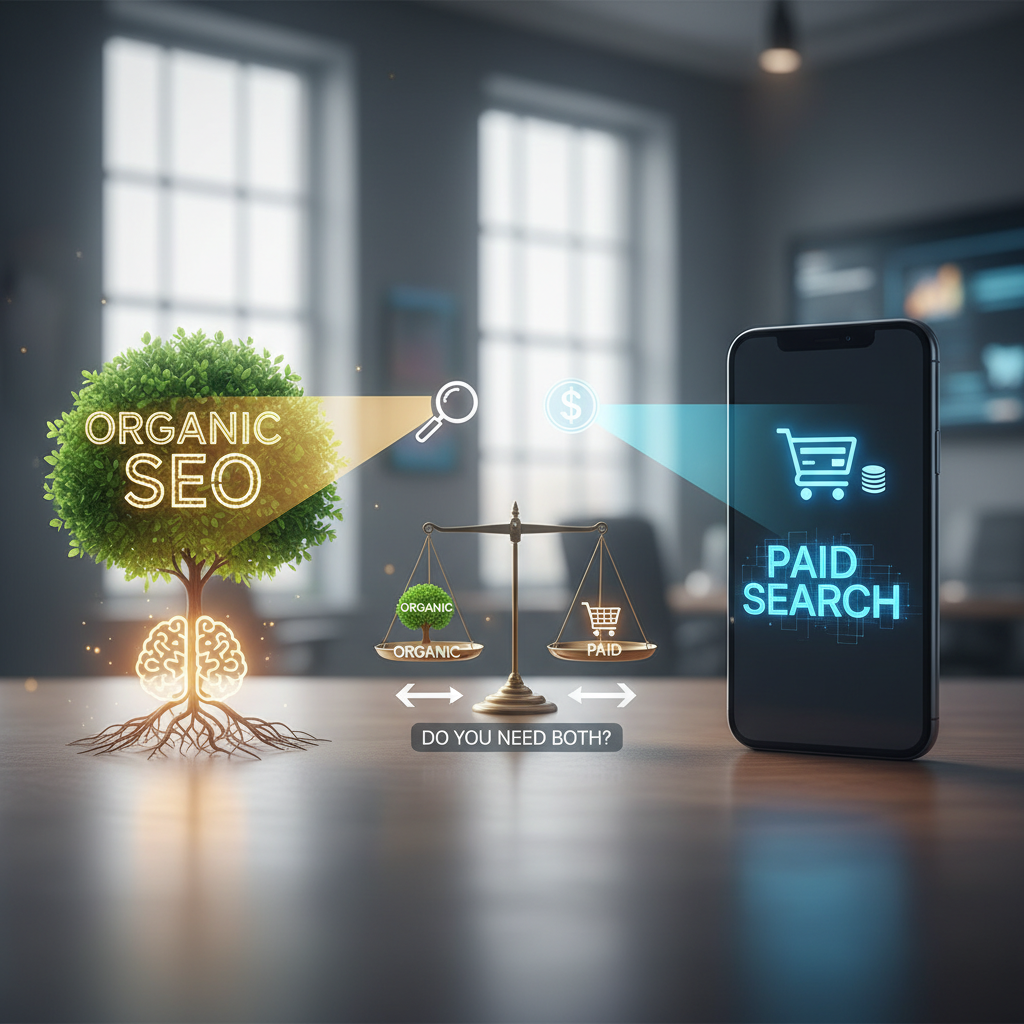
Organic SEO generates free traffic through search engine ranking optimization, whereas paid search delivers instant visibility through pay-per-click advertising on platforms like Google Ads. Organic SEO builds sustainable long-term rankings through content optimization, link building, and technical improvements. Paid search provides immediate placement above organic results but requires continuous ad spend. Most successful businesses use both organic and paid search working together to maximize search visibility and traffic generation across the entire Search Engine Results Page (SERP).
What Is the Difference Between Organic SEO and Paid Search?

Search Engine Optimization (SEO) focuses on earning natural search results through website optimization and content marketing. According to Google Search Console data from 2024, organic listings appear below paid advertisements on the SERP and cannot be purchased directly. Organic search marketing builds domain authority through white hat SEO practices including on-page SEO, off-page SEO, and technical SEO improvements.
Pay Per Click (PPC) advertising, also called paid search advertising or search engine advertising, places sponsored listings at the top of search results. Google Ads (formerly Google AdWords) charges advertisers based on Cost Per Click (CPC) when users click sponsored ads. Paid search campaigns deliver instant traffic through bidding strategies and keyword targeting on platforms including Google, Bing, and Yahoo.
The fundamental distinction lies in earned media vs paid media approaches. Organic SEO represents an investment in sustainable rankings, while paid promotion requires continuous advertising budget allocation to maintain visibility.
Organic vs Paid Search: Feature Comparison Table

| Feature | Organic SEO | Paid Search (PPC) |
|---|---|---|
| Cost Structure | SEO investment in content, technical optimization (no per-click cost) | Continuous ad spend, bidding competition determines CPC |
| Timeline to Results | 3-6 months for competitive keywords; SEO timeline varies by search competitiveness | Immediate results; ads appear within hours of campaign launch |
| SERP Placement | Organic placements below paid ads; influenced by ranking factors and search algorithm | Top paid placements above organic results; determined by Ad Rank and Quality Score |
| Click-Through Rate | Higher CTR for top 3 organic positions (28-45% combined, according to 2024 data) | Lower organic vs paid search click through rates (2-5% average for paid ads) |
| Sustainability | Rankings persist without continuous payment; organic independence from ad dependency | Visibility disappears when advertising budget stops; requires ongoing investment |
| Targeting Control | Limited to keyword optimization, search intent alignment, content relevance | Precise keyword bidding, demographic targeting, ad placement control, geographic filtering |
| Trust & Credibility | Users perceive organic credibility (70% prefer natural search results) | Ad-based traffic viewed as promotional; lower inherent trust |
| Measurability | Google Analytics tracks organic traffic; attribution challenges for conversions | Precise ROAS measurement; direct conversion tracking; clear Return on Ad Spend |
How Do Organic SEO and Paid Search Differ in Cost and ROI?
Organic search optimization requires upfront marketing investment without direct advertising costs. According to industry research from 2024, businesses spend $5,000-$30,000 monthly on SEO services including content creation, backlinks acquisition, and technical improvements. This SEO investment builds cumulative value over time with no per-click expense.
Paid search operates on a variable cost model determined by keyword competition and bidding competition. Average CPC ranges from $1-$50 depending on industry and search demand. High-value keywords in sectors like legal services or insurance can exceed $100 per click. The PPC budget must be maintained continuously to preserve visibility.
Return on Investment (ROI) differs substantially between approaches. Organic SEO delivers compounding returns—once rankings achieve top positions, ongoing traffic arrives without proportional cost increases. A website ranking #1 for a 10,000 monthly search volume keyword generates approximately 3,000 organic clicks monthly at essentially zero marginal cost.
Paid search provides predictable, linear ROI. If an ad campaign generates $5 revenue per $1 spent, doubling ad spend typically doubles returns (assuming sufficient search volume). This predictability helps with marketing budget allocation but creates ad dependency—traffic stops immediately when campaigns pause.
For cost-effective marketing over 12+ months, organic SEO typically delivers superior lifetime value. According to 2024 marketing benchmarks, organic traffic acquisition cost averages $0.50 per visit versus $2.75 for paid traffic acquisition across most industries.
What Are the Timeline Differences Between Organic and Paid Results?
The SEO timeline extends significantly longer than the PPC timeline. New websites require 4-6 months to rank for moderately competitive keywords through content optimization and link building. Highly competitive short-tail keywords may take 12-18 months to achieve first-page placement, according to ranking difficulty analysis from 2024.
Paid search delivers instant traffic within hours. Once a Google Ads campaign launches with appropriate keyword targeting and bidding strategies, sponsored listings appear immediately on relevant SERPs. This speed advantage makes paid search ideal for time-sensitive promotions, product launches, or seasonal campaigns.
However, long-term SEO builds ranking positions that persist and strengthen over time. A well-optimized page ranking #3 today may climb to #1 within months as domain authority increases through continued content marketing and backlinks. These sustainable rankings provide traffic consistency without ongoing payment.
In contrast, paid visibility requires continuous investment. Pausing a campaign for even one day eliminates all paid placements and associated traffic. This creates vulnerability during budget constraints or seasonal business fluctuations.
Smart marketers use both organic and paid search for maximum visibility during the SEO timeline. Launch paid search campaigns immediately for instant results while simultaneously building long term benefits of organic SEO. As organic rankings improve over 6-12 months, gradually reduce paid search dependency to optimize overall marketing investment.
How Do Organic vs Paid Search Affect Click-Through Rates and Trust?
User behavior studies from 2024 reveal stark differences in organic search vs paid search click through rates. The top three organic results collectively capture 54-68% of all clicks on desktop searches. The #1 organic position alone receives 28-35% CTR for informational queries.
Paid ads receive substantially lower engagement despite premium ad placement. Average Click Through Rate for paid search ads ranges from 2-5% across industries. Even top-position sponsored listings underperform the #1 organic result by 6-8x in most verticals.
This disparity stems from organic credibility versus perceived promotional intent. According to search behavior research, 70% of users specifically avoid clicking ads, preferring free search results they perceive as more trustworthy. Natural traffic generated through earned rankings signals authority and relevance that paid promotion cannot replicate.
However, paid search excels for high commercial intent searches. Queries like “buy running shoes online” or “emergency plumber near me” show higher ad CTRs (8-12%) as users recognize ads provide direct solutions. Transactional long-tail keywords benefit more from paid visibility than informational queries.
Brand awareness also improves through combined search channel mix visibility. Businesses appearing in both paid and organic results capture greater search market share. According to 2024 Google data, combined presence increases total CTR by 25-40% compared to organic-only visibility.
What Keywords Work Best for Organic SEO vs Paid Search?
Effective keyword research reveals different opportunities for each channel. Long-tail keywords (4+ words, specific search intent) perform exceptionally well in organic SEO vs PPC. These phrases like “benefits of combining organic SEO and paid search” have lower search volume but higher conversion potential and minimal bidding competition.
Organic search strategy should prioritize:
- Informational long-tail keywords with educational search intent
- Industry terminology with high search volume but manageable keyword difficulty
- Location-based phrases for local business organic placements
- Question-based queries aligned with content marketing strategies
- Branded terms to protect domain authority and page authority
Paid media strategy works best for:
- High-intent commercial short-tail keywords with immediate purchase signals
- Competitive phrases where organic search vs paid search competition makes ranking difficult
- Seasonal keywords requiring instant visibility during limited timeframes
- New product launches before organic search optimization builds ranking positions
- Competitor branded terms for market share acquisition
Many businesses discover that organic and paid search use the same keywords but at different customer journey stages. Target broad informational queries organically for awareness, then retarget with paid ads for conversion optimization.
According to keyword targeting analysis from 2024, the optimal blended search strategy uses paid search for 20-30% of keywords (high-value, high-competition terms) while building organic rankings for the remaining 70-80% (long-tail, informational, sustainable traffic keywords).
When Should You Use Organic SEO vs Paid Search?
Use Organic SEO When:
Building sustainable, long-term visibility – Organic growth provides compound returns over 12+ months. Businesses prioritizing cost-effective marketing beyond immediate quarters benefit from SEO investment.
Targeting informational queries – Users researching solutions, comparing options, or learning about topics strongly prefer natural search results. Content optimization drives qualified traffic for educational content.
Limited ongoing budget exists – After initial SEO timeline investment, organic traffic arrives without per-click costs. Small businesses and startups often achieve better ROI through organic independence versus continuous ad spend.
Establishing industry authority – High organic rankings signal expertise and trustworthiness. Professional services, B2B companies, and thought leaders gain organic credibility that paid ads cannot replicate.
Use Paid Search When:
Immediate results required – Product launches, event promotions, or seasonal campaigns demand instant traffic. Paid search campaigns deliver within hours versus months.
Targeting high-intent buyers – Commercial queries with purchase signals convert effectively through sponsored listings despite lower CTR. Lead generation and ecommerce benefit from precise keyword bidding.
Testing new markets or keywords – Before committing to long-term SEO investment, validate demand through paid search data. Conversion rates from PPC inform organic search strategy prioritization.
Competing in saturated markets – When ranking difficulty exceeds realistic organic potential, paid visibility provides accessible entry. Highly competitive industries like insurance or legal services require paid search for top placement.
Use Both Organic and Paid Search When:
Maximizing total search visibility – Dominating both natural search and paid ads captures combined 50-70% click share for target keywords. Traffic diversification protects against algorithm changes or budget fluctuations.
Covering full customer journey – Use organic for awareness (top-funnel), paid for consideration and conversion (mid/bottom-funnel). Integrated marketing strategy supports users at every search stage.
Achieving fastest sustainable growth – Launch with paid search for immediate revenue while building organic rankings. As natural traffic increases, optimize advertising budget allocation toward new keywords or reduced dependency.
Protecting brand presence – Competitors may bid on your branded terms. Maintain both organic rankings and defensive paid campaigns to control brand-related search result types.
How Organic SEO and Paid Search Work Together
The most effective approach combines organic SEO with paid search through holistic search approach planning. According to combined SEO and PPC research from 2024, businesses using both channels generate 25% more revenue than those relying on single-channel strategies.
Key integration tactics include:
Using paid search data to improve organic SEO – PPC campaigns reveal actual conversion rates, search query variations, and user language. Apply these insights to content creation, meta description optimization, and title tag refinement for organic pages.
Retargeting organic visitors through paid ads – Users who visit via organic clicks but don't convert can be retargeted with display or search ads. This blended search strategy improves overall conversion optimization.
Covering gaps in organic rankings with paid ads – While building natural search rankings for competitive terms, maintain visibility through temporary paid campaigns. As organic positions improve, gradually reduce ad spend for those keywords.
Testing content performance before SEO investment – Create landing pages for paid traffic to validate messaging and conversion potential. High-performing ad content can then justify deeper on-page SEO and link building investment for organic growth.
Dominating high-value SERPs completely – For critical business keywords, appear in both paid placements and organic listings. This visibility strategy captures maximum search market share and blocks competitor presence.
For detailed guidance on organic SEO vs. paid search explained, consider professional evaluation of your specific market conditions and competition.
Decision Framework: Choosing Your Search Marketing Mix
Choose primarily organic SEO if:
- Your business has 12+ month planning horizons and patient growth expectations
- Limited ongoing budget prevents sustainable PPC budget commitments
- Content marketing and thought leadership align with business model
- Target keywords have manageable ranking difficulty and competition
- Building sustainable rankings matters more than immediate sales
Choose primarily paid search if:
- Immediate revenue generation outweighs long-term organic investment
- Product/service margins support ongoing advertising costs profitably
- Markets show extreme search competitiveness blocking realistic organic rankings
- Seasonal business models require flexible traffic control
- Testing new offerings before committing to content development
Invest in both organic and paid search when:
- Budget allows for comprehensive search engine marketing across channels
- Competitive advantage requires maximum search visibility and web traffic
- Different keywords justify different approaches based on intent and difficulty
- Business growth plans include both immediate returns and sustainable foundations
- Data from one channel can improve performance in the other
Conclusion: Organic vs Paid Search for Your Business
The question is not whether to choose organic SEO or paid search, but how to balance organic SEO and paid search budget for your specific situation. Natural search results provide sustainable rankings, higher CTR, and long-term cost efficiency. Paid search advertising delivers instant visibility, precise targeting, and measurable short-term returns.
According to 2024 digital marketing data, businesses allocating 60-70% of search budgets to organic SEO and 30-40% to paid search achieve optimal traffic consistency and ROI balance. This integrated approach captures immediate opportunities while building sustainable competitive advantages.
Evaluate your timeline, budget, competition, and business goals. Most successful companies discover that organic SEO and paid search strategy for beginners starts with paid campaigns for learning and immediate results, then progressively shifts toward organic dominance as rankings mature. This evolution from paid search to organic SEO maximizes both immediate performance and long-term value creation.