
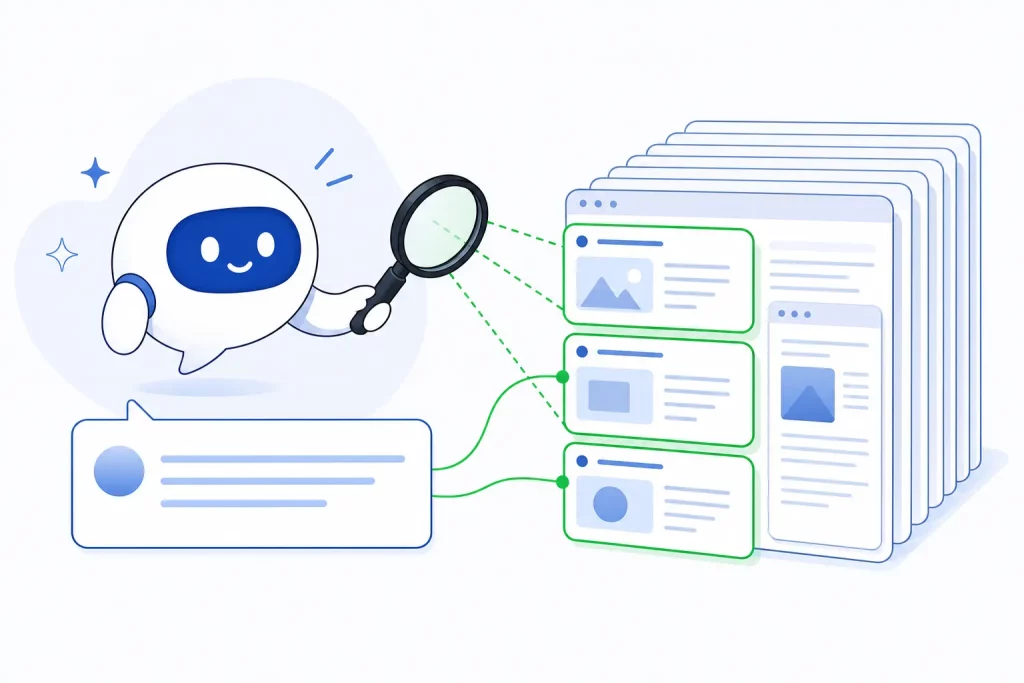
AI search engines choose their sources in two steps. First they search: the tool turns your question into one or more search queries and pulls candidate pages from a search index, either Google’s, Bing’s or its own. Then a language model reads those pages, writes the answer, and cites the pages it relied on. A page gets cited when it is in the index the tool searches, comes back for one of those queries, and answers the question clearly enough that the model uses it.
This article explains how that works and what changes from one tool to the next. It’s the “how it works” piece. If you want the to-do list, our guides on getting cited by ChatGPT and Perplexity, ranking in Google AI Mode and AI search optimization for local businesses cover the steps.
Search First, Then Write: How AI Answers Are Built
The technical name for this is retrieval-augmented generation, or RAG. The model doesn’t answer only from memory. It retrieves fresh documents first and then generates an answer grounded in them.
Here is the basic order of events:
- You ask a question.
- The tool decides whether it needs to search. OpenAI says ChatGPT “will choose to search the web based on what you ask”.
- It writes its own search queries, often several.
- It pulls candidate pages from a search index.
- The model reads the best candidates and writes an answer.
- It links the pages it used as citations.
The key point for a business owner: if your page doesn’t come back in step 4, it can’t be cited in step 6. Most of the work of being cited is work on being found.
Query Fan-Out: Why One Question Becomes Many Searches
AI tools rarely search for your exact words. Google says in its documentation on AI features that “Both AI Overviews and AI Mode may use a ‘query fan-out’ technique,” which means running several related searches across subtopics before writing a response.
Microsoft describes the same idea for Copilot. Its documentation on Copilot web search says Copilot “generates a search query that it sends to the Bing search service,” and that this query “is different from the user’s original prompt.”
Take a question like “Who’s the best roofer in Encinitas for an older home?” Behind the scenes, the tool might search for roofers in Encinitas, roof repair for older homes, roofer reviews, and what a roof inspection includes. Each of those searches is a separate chance for a different page to be pulled in. A page that answers one sub-question well can be cited even if it isn’t the best match for the full question.
What Makes a Page Likely to Be Retrieved and Cited
None of these companies publish their ranking weights. The list below comes from how retrieval works and from what Google, OpenAI, Perplexity and Microsoft do publish.
- It’s indexed and crawlable. Google says a page “must be indexed” to be shown as a supporting link in AI Overviews or AI Mode. Other tools need their own crawler or search partner to reach the page.
- It gives a clear, direct answer. A model can quote a page that states the answer in plain words near the top far more easily than one that buries it under an intro.
- It matches a sub-question. Pages that cover the follow-up questions (cost factors, timing, service area, what to expect) have more chances to come back during fan-out.
- Other sites back it up. Mentions, reviews and links from other sites are how search indexes judge trust. Retrieval inherits those signals.
- It’s current. Live retrieval exists to get up-to-date information, so old dates, outdated prices or stale hours work against a page.
- It’s easy to break into pieces. Clear headings, short paragraphs, lists and tables let a model pull out the one passage it needs. Our article on entity SEO covers why consistent facts about your business matter too.
How Each AI Tool Finds Its Sources
Every tool follows the same search-then-write pattern, but they search different places. That’s why a business can be cited in one tool and missing from another.
| AI tool | Where it searches | Crawler to allow |
|---|---|---|
| Google AI Overviews and AI Mode | Google’s search index | Googlebot |
| ChatGPT search | Third-party search providers, partner content, and OpenAI’s own crawler | OAI-SearchBot |
| Perplexity | Its own crawler and index, with numbered citations | PerplexityBot |
| Microsoft Copilot | Bing search | Bingbot |
Google AI Overviews and AI Mode
These run on Google Search itself. Google says there are no extra requirements: if a page is indexed and eligible to appear in Search with a snippet, it can be used. In practice, regular SEO is the entry ticket. Our guide to ranking in Google AI Mode goes deeper.
ChatGPT Search
When OpenAI launched ChatGPT search in October 2024, it wrote that “ChatGPT search leverages third-party search providers, as well as content provided directly by our partners.” OpenAI also runs its own crawler. Its crawler documentation says “OAI-SearchBot is used to surface websites in search results in ChatGPT’s search features.” OpenAI says sites that block OAI-SearchBot are kept out of ChatGPT search answers, though they can still show up as a plain navigational link.
Perplexity
Perplexity shows its sources as numbered citations next to each answer. Its crawler documentation says “PerplexityBot is designed to surface and link websites in search results on Perplexity.” A separate agent, Perplexity-User, fetches pages when a user’s request needs them.
Microsoft Copilot
Copilot pulls web results from the Bing search service. If Bing hasn’t indexed your page, Copilot is unlikely to cite it. Check your site in Bing Webmaster Tools, not only Google Search Console.
Training Data vs Live Retrieval
An AI model knows things in two ways. It learned some facts during training, months or years ago. It looks up other facts live when it searches. Citations come from the live lookup.
Companies use different crawlers for each job, and you can treat them differently. OpenAI says “GPTBot is used to make our generative AI foundation models more useful and safe,” while OAI-SearchBot powers search, and “Each setting is independent of the others.” So you can block GPTBot from training on your content and still allow OAI-SearchBot so ChatGPT can cite you. Perplexity says PerplexityBot “is not used to crawl content for AI foundation models.”
Google works differently. AI Overviews and AI Mode follow your normal Search controls (noindex, nosnippet, data-nosnippet and max-snippet). Google points to a separate token, Google-Extended, for limiting training and grounding in some of its other AI systems.
What You Can’t Control
- The sub-queries. The tool decides what to search for, not you.
- The wording of the answer. The model summarizes in its own words and may cite you without anyone clicking.
- Consistency. Ask the same question twice, or from a different city, and the sources can change.
- Partner content. Deals between AI companies and publishers decide some of what gets fed in.
What you can control is whether you’re findable, clear, current and well backed up by other sites. That’s where the effort pays off.
How to Check Which Sources Get Cited for Your Questions
- Write down 10 real customer questions, like “how much does a water heater replacement take” or “best dentist in Indianapolis for kids.”
- Ask each one in Google, ChatGPT, Perplexity and Copilot, logged out or in a private window.
- Record every cited URL in a spreadsheet: yours, competitors’, directories, Reddit, news sites.
- Look for patterns. If directories win, your listings matter most. If competitor service pages win, compare their answers with yours.
- Confirm your pages are indexed with URL Inspection in Google Search Console and in Bing Webmaster Tools.
- Repeat monthly, since sources shift.
In Microsoft Copilot Chat, the citation section shows the exact web search queries Copilot sent to Bing, which is a free look at fan-out in action. For a fuller process, see our guide to tracking whether your business appears in AI answers.
Where to Go Next
- How to get cited by ChatGPT and Perplexity: page-level steps for the two tools that cite most visibly.
- How to rank in Google AI Mode: Google’s AI search tab specifically.
- AI search optimization for local businesses: listings, reviews and local sources.
- SEO vs AEO vs GEO: what the terms mean.
Frequently Asked Questions
Do AI search engines use the same sources as Google?
Only Google’s own AI features use Google’s index. ChatGPT uses third-party search providers, partner content and its OAI-SearchBot crawler. Perplexity uses its own crawler, and Copilot uses Bing. Ranking well in Google helps, but it doesn’t guarantee you’ll be cited everywhere.
Does blocking GPTBot keep my site out of ChatGPT search?
No. OpenAI says GPTBot and OAI-SearchBot are independent. GPTBot covers model training. OAI-SearchBot covers ChatGPT search. Allow OAI-SearchBot if you want ChatGPT to be able to cite your pages.
Why does the AI cite my competitor instead of me?
Usually their page came back for one of the tool’s searches and answered it more directly. Check that your page is indexed in both Google and Bing, put the answer near the top, cover the follow-up questions, and build mentions and reviews on other sites.
Do I need special markup to be cited in AI answers?
Not for Google. Google says AI Overviews and AI Mode have no extra requirements beyond being indexed and eligible for a snippet. Schema still helps machines read your facts, but clear, crawlable text matters more.
Find Out Which Sources AI Tools Trust in Your Market
Local Blitz has helped businesses get found online since 2009, from offices in Encinitas (San Diego) and Indianapolis. Our AI search optimization work starts by mapping which pages Google, ChatGPT, Perplexity and Copilot cite for your customers’ questions. Plans are month-to-month. Book a free strategy call and we’ll show you who gets cited in your market today and why.
Is AI recommending your business?
We will ask ChatGPT, Gemini and Google AI about your business and show you what they say. It is free.
Want More Customers From Search?
Book a free strategy call, or call San Diego (858) 225-6877 or Indianapolis (317) 672-1156.