
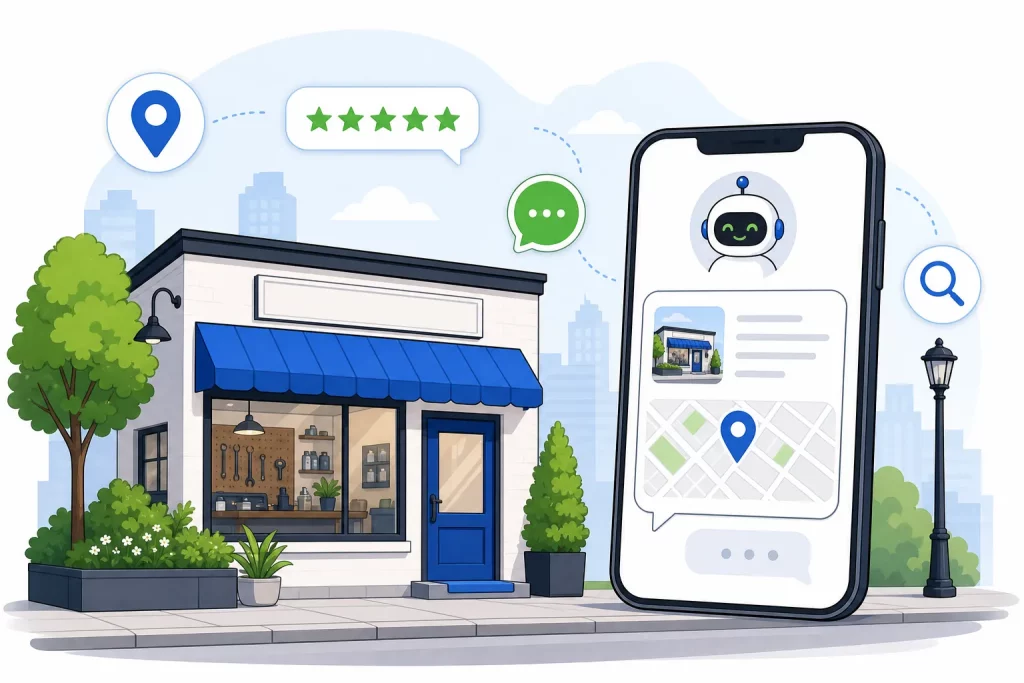
AI search optimization for local businesses is the work of making sure tools like ChatGPT, Google AI Overviews, Gemini, Microsoft Copilot and Siri can find your business, trust its details, and name it when a customer asks for a recommendation in your city. It rests on the same foundations as local SEO: an accurate Google Business Profile, consistent listings, real reviews and a clear website. Each AI tool reads them from different sources.
This guide covers which sources each AI tool uses for local answers, the steps that matter most, how long it takes, and how to check whether it’s working. If you’re new to the terms, start with the difference between SEO, AEO and GEO.
How AI Search Tools Choose Local Businesses
There isn’t one “AI search.” Each assistant pulls local facts from its own sources, so a business can show up in one and be missing from another. Here is where each tool gets its local data:
| AI tool | Main local data sources | What to own |
|---|---|---|
| Google AI Overviews and AI Mode | Google’s search index and Google Business Profile | Google Business Profile, an indexable website |
| Gemini | Google Search and Google Maps data | Google Business Profile |
| ChatGPT | Web search results, business websites, and licensed Yelp reviews and listings | Your website, Yelp listing, third-party mentions |
| Microsoft Copilot | Bing search and Bing Places | Bing Places for Business listing |
| Siri and Apple Maps | Apple Maps place cards | Apple Business Connect listing |
Google AI Overviews for Local Queries
Google says there are no extra requirements or special optimizations for AI Overviews or AI Mode. A page only needs to be indexed and eligible to show in Search with a snippet. Google’s own advice for businesses is to keep your Business Profile information up to date. Google also explains that these features run several related searches across subtopics before writing an answer (it calls this “query fan-out”), so a page that answers the follow-up questions has more chances to be used.
Distance seems to matter less here than in the map pack. A 2025 Local Falcon study found that how close a business is had little effect on the order businesses appear in AI Overviews, compared with the traditional local pack. More on this in our guide to ranking in Google’s AI Overviews, and for Google’s conversational search tab, see how to rank in Google AI Mode.
ChatGPT Local Recommendations
ChatGPT leans heavily on business websites. In BrightLocal’s study of 800 local searches in ChatGPT (November 2024), business websites made up 58% of the sources cited, mentions on other sites 27%, and directories 15%. For transactional searches like “plumber in [city],” business websites were 72% of sources.
Then the sources changed. In July 2026, Yelp licensed its reviews, photos and business information to OpenAI for ChatGPT’s local answers, with Yelp branding and links shown when its content is used. The takeaway: your website still matters most, and your Yelp listing now matters for ChatGPT too.
Gemini, Copilot and Siri
Gemini is built on Google, so the same Google Business Profile that feeds Maps feeds it. Microsoft Copilot answers local questions with Bing data, which comes from Bing Places for Business. Siri and Apple Maps use the place cards businesses manage in Apple Business Connect. All three listings are free to claim.
What You Need Before You Start
- Your exact business name, address and phone number, written the same way everywhere (often called NAP).
- Owner access to your Google Business Profile.
- A website that Google can crawl and index, with one page per main service.
- Logins (or the ability to claim) Bing Places, Apple Business Connect and Yelp.
- A list of the questions customers ask before they hire you.
Step-by-Step: How to Get Your Local Business Into AI Answers
1. Complete and Verify Your Google Business Profile
Pick the most specific primary category, add every service you offer, set accurate hours (holiday hours too), write a plain description of what you do and where, and add real photos. This one profile feeds Google Maps, AI Overviews, AI Mode and Gemini. Our Google Business Profile optimization guide walks through each field, and our list of Google Maps ranking factors shows what else decides who appears on the map.
2. Claim Bing Places, Apple Business Connect and Yelp
These three cover Copilot, Siri and ChatGPT. Bing Places can import your Google profile, which saves time. Make sure the name, address, phone, hours and categories match Google exactly.
3. Make Your Business Details Consistent Everywhere
AI tools cross-check facts. When directories disagree on your address, phone or name, the business is harder to trust and easier to skip. Fix old listings, merge duplicates, and update anything left from a move or rebrand. This is what “entity consistency” means: every source describes the same business the same way.
4. Build a Steady Flow of Real Reviews
AI answers often summarize what reviewers say, not only the star rating. Ask every happy customer for a review on Google, and on Yelp where it’s common in your industry, and reply to each one. Reviews that mention the service and the town (“they fixed our roof in Carmel”) give AI tools more to work with. Never buy or filter reviews. It breaks platform rules and can get a listing suspended.
5. Write Website Pages That Answer Local Questions Directly
Since business websites are ChatGPT’s biggest local source, your pages need to say clearly what you do, where, and for whom. Start each service page with a one or two sentence answer, then cover the follow-up questions: cost factors, timelines, service areas, and what sets you apart. Add a short FAQ to each service page. Our guide on getting cited by ChatGPT and Perplexity covers the page-level details.
6. Add LocalBusiness Schema That Matches the Page
Google says no special schema is needed for its AI features, so don’t expect schema alone to get you in. It still helps machines read your name, address, phone, hours and service area without guessing, and it must match what visitors can see on the page. See what schema is and how it works.
7. Earn Mentions on Local and Industry Sites
Mentions on other sites were 27% of ChatGPT’s local sources in the BrightLocal study. Local news, chamber of commerce pages, sponsorships, industry associations and “best of” lists in your city all count. One good local article usually does more than dozens of low-quality directory listings.
8. Let AI Crawlers Read Your Site
Check that your robots.txt and security tools don’t block search and AI crawlers like Googlebot, Bingbot and OAI-SearchBot, and that your key text is in the page itself rather than loaded by scripts or shown only in images. An llms.txt file is optional. Google says its features don’t need one.
How Long AI Search Optimization Takes
Listing fixes are the fast part: claiming and correcting profiles usually takes days to a few weeks, plus verification time. AI tools then have to pick up the changes, which depends on how often they refresh their sources. Reviews and local mentions build up over months. Expect it to work the way local SEO does: steady effort, not a one-time switch.
How to Measure Whether It’s Working
- Ask the AI tools yourself. Each month, run the same five to ten questions customers would ask (“best [service] in [city]”) in ChatGPT, Gemini, Copilot and Google, logged out, and note whether you’re named.
- Watch your Business Profile insights for calls, direction requests and website clicks.
- Check referral traffic in Google Analytics from chatgpt.com, perplexity.ai, copilot.microsoft.com and gemini.google.com.
- Ask new leads how they found you, and add “ChatGPT or another AI tool” as an option on your forms.
Our guide to tracking AI search visibility covers this in more detail.
Tools for Local AI Search Optimization
- Free listing tools: Google Business Profile, Bing Places for Business, Apple Business Connect, Yelp for Business.
- Google Search Console to confirm your pages are indexed and eligible for snippets.
- Google’s Rich Results Test to check your schema.
- A listings management tool to find and fix inconsistent directory listings across many sites.
Frequently Asked Questions
Is AI search optimization different from local SEO?
Mostly no. The same signals carry over: an accurate Google Business Profile, consistent listings, reviews and clear service pages. The difference is coverage. AI tools also read Bing Places, Apple Business Connect and Yelp, and they reward pages that answer questions directly.
Can I pay to be recommended by ChatGPT?
Not in the regular answers. ChatGPT’s local recommendations come from the sources it reads, such as websites, mentions and licensed Yelp data. The way in is to be accurate, well reviewed and clearly described in those sources.
Why does ChatGPT recommend my competitor and not me?
Usually because their information is easier to find and confirm: more reviews, more mentions on other sites, a site that states their services and city plainly, or a Yelp listing where yours is missing. Run the steps above and check again in a month or two.
Do I need a special file or schema to show up in Google’s AI Overviews?
No. Google says no AI text files, special markup or special schema are needed. Your page has to be indexed and eligible to show with a snippet, and your Business Profile should be up to date.
Get Help With AI Search in Indianapolis or San Diego
Local Blitz handles AI search optimization and local SEO for businesses in Indianapolis, San Diego and beyond. If you want to know where you stand today, book a free strategy call and we’ll show you what ChatGPT, Gemini and Google say about your business right now.
Is AI recommending your business?
We will ask ChatGPT, Gemini and Google AI about your business and show you what they say. It is free.
Want More Customers From Search?
Book a free strategy call, or call San Diego (858) 225-6877 or Indianapolis (317) 672-1156.