
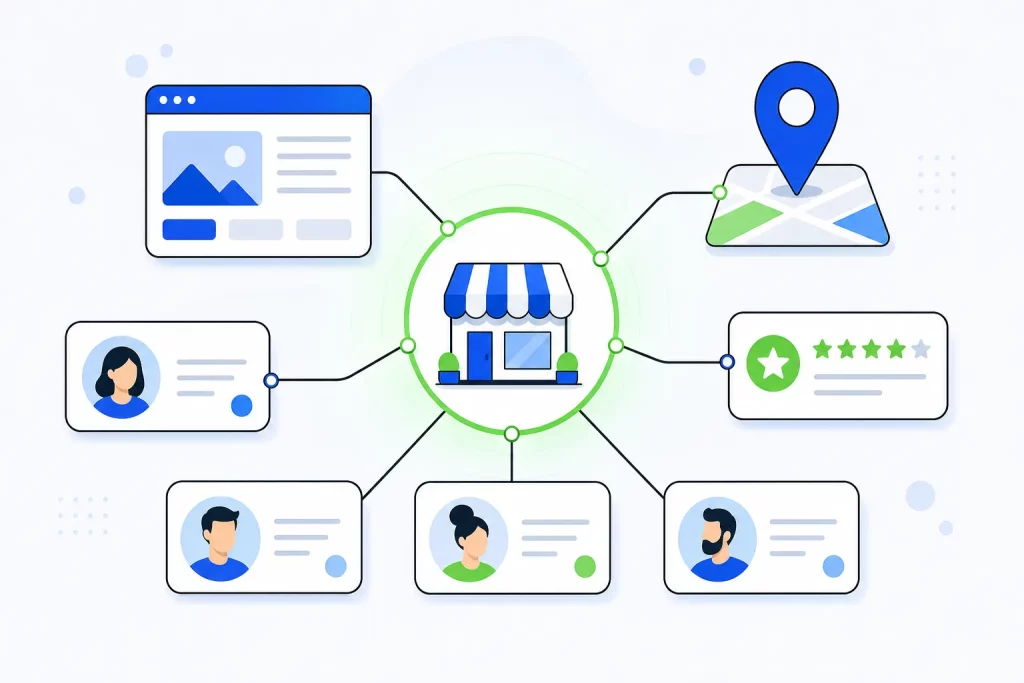
Entity SEO is the work of making search engines and AI tools recognize your business as one clear, distinct thing, with the same name, address, phone number, website and services everywhere they look. An entity is anything that can be uniquely identified: a person, a place, a company, a product. When Google and tools like ChatGPT are confident your business is a single, well-described entity, they can match it to the right searches and describe it correctly.
This guide covers how entities and Google’s Knowledge Graph work, which facts connect your business together, how to describe it with schema markup, and how to check what Google and AI tools think you are.
What Is an Entity in SEO?
An entity is a thing, not a word. “Mercury” is a word. Mercury the planet, Mercury the element and Freddie Mercury are three different entities that share it. Search engines try to work out which one you mean.
Your business is an entity too. So is your city, your service (“water heater installation”), your owner and your industry. Entity SEO is about making the links between those things obvious, so a machine doesn’t have to guess.
Entities and Google’s Knowledge Graph
Google introduced its Knowledge Graph in 2012 with a post titled “Introducing the Knowledge Graph: things, not strings”. The idea was simple: instead of only matching the letters in a query, Google would understand real-world entities and how they relate to each other.
The Knowledge Graph is a store of facts about those entities. Google’s help center explains that Knowledge Panels are created automatically from a variety of sources across the open web, plus some licensed data and information from content owners. For businesses, Google points you to your Business Profile to manage what appears.
AI tools work in a similar way. A large language model answering “who’s a good plumber in Springfield?” has to connect a business name to a location, a service and some proof that it’s real. The clearer and more consistent your facts are, the easier that connection is to make.
How Google and AI Tools Connect the Facts About Your Business
Machines build a picture of your business by matching the same facts across many sources. The core facts are:
- Name. Your real business name, written the same way everywhere. No keyword stuffing.
- Address and phone. The same format on your site, your Google Business Profile and every directory. This is often called NAP. Our guide to local citations and NAP consistency covers how to clean it up.
- Website. One official domain that every profile points back to.
- Profiles that point to each other. Your Facebook, LinkedIn, Yelp and industry profiles should link to your site, and your site should list them. In schema, these go in the
sameAsproperty. - Category. What you are. Your Google Business Profile categories are one of the clearest signals you control.
Why Consistency Across Citations Matters
If your site says “Example Plumbing Co,” Yelp says “Example Plumbing and Drain” and an old directory lists a phone number you dropped years ago, a machine may not be sure those are the same business. It might merge them, split them or trust neither. Every mismatch is a small reason to doubt.
Fixing this is unglamorous work: list every place your business appears, then correct the name, address, phone and website on each one.
Wikipedia and Wikidata
Wikipedia and Wikidata are strong entity sources, but only for organizations that are genuinely notable, meaning independent publications have written about them in depth. Most local businesses aren’t, and that’s fine. Don’t create a Wikipedia page about your own company. Wikipedia’s conflict of interest guideline says this kind of editing is strongly discouraged, and pages that don’t meet the bar tend to get deleted. If an article about you already exists, link to it in your sameAs list.
Describe Your Business With Organization or LocalBusiness Schema
Schema markup is code that states your facts in a format machines read directly. Google’s Organization structured data documentation says it can help Google disambiguate your organization in search results, and that local businesses should use the most specific LocalBusiness subtype, such as Plumber, Dentist or Restaurant. For a full walkthrough, see our guide to schema markup.
Two properties do most of the entity work:
@idgives your business a permanent identifier, usually your homepage URL plus a fragment like#business. Use the same@idon every page so all your markup points at one entity instead of creating new ones.sameAslists the URLs of your official profiles on other sites. Google describes it as a page on another website with more information about your organization.
Here’s a short example for a fictional business:
{
  "@context": "https://schema.org",
  "@type": "Plumber",
  "@id": "https://www.exampleplumbing.com/#business",
  "name": "Example Plumbing Co",
  "url": "https://www.exampleplumbing.com/",
  "telephone": "+1-555-555-0100",
  "address": {
    "@type": "PostalAddress",
    "streetAddress": "123 Main St",
    "addressLocality": "Springfield",
    "addressRegion": "IL",
    "postalCode": "62701",
    "addressCountry": "US"
  },
  "sameAs": [
    "https://www.facebook.com/exampleplumbingco",
    "https://www.linkedin.com/company/exampleplumbingco",
    "https://www.yelp.com/biz/example-plumbing-co-springfield"
  ]
}
Only include facts that are true and that also appear on your site. Google’s structured data guidelines say not to mark up content that isn’t visible to readers.
Build Topical Entities Into Your Pages
Entity SEO isn’t only about your business. Each page is also about something, and search engines read the related entities on it to understand the topic.
A page about water heater installation will naturally mention tank and tankless models, gas and electric units, permits, the brands you install and the neighborhoods you serve. Those mentions tell machines what the page covers and how deep it goes. Write them because a customer would want them, not to hit a list.
- Name things specifically. “Tankless water heaters” says more than “newer options.”
- Name your service area. Cities and neighborhoods are entities, too.
- Link related pages together. Internal links from a service page to its city page, and back, show how your topics connect.
- Answer the follow-up questions. Our guide to answer engine optimization explains why that matters for AI answers.
How to Check How Google and AI Tools See Your Business
You don’t need special software for a first look.
- Search your brand name. Does a Knowledge Panel or Business Profile show up? Are the hours, phone and website right?
- Search your name plus your city. Check which listings rank and whether their details match.
- Ask AI tools. Ask ChatGPT, Gemini and Copilot “What is [your business] and what does it do?” and “Who are the best [service] companies in [city]?” Note what they get wrong.
- Test your schema. Paste a page into Google’s Rich Results Test to see what markup Google can read.
If AI answers are wrong or missing, the fix is usually upstream: inconsistent listings, a thin About page or a site that doesn’t say plainly what you do and where. Our 5-step guide to getting recommended by ChatGPT, Gemini and AI search walks through those fixes.
Entity SEO and AI Search
Google says there’s no special schema needed to appear in AI Overviews or AI Mode, and that your structured data should match the visible text on the page. So entity SEO isn’t a trick for AI. It’s the groundwork that lets any system, old or new, recognize you. If you want to go further, read our guides to AI search optimization for local businesses and ranking in Google AI Mode.
Frequently Asked Questions
Is entity SEO different from regular SEO?
It’s part of it. Regular SEO focuses on pages and keywords. Entity SEO focuses on the business behind the pages, making sure search engines and AI tools know who you are, what you do and where you are, and that every source agrees.
Do I need a Wikipedia page for entity SEO?
No. Most local businesses don’t meet Wikipedia’s notability bar, and Wikipedia strongly discourages writing about your own company. Consistent listings, a clear website, Organization or LocalBusiness schema and a verified Google Business Profile matter far more.
How do I get a Knowledge Panel for my business?
For a local business, the panel usually comes from your Google Business Profile, so claim and verify it and keep it complete. Google creates panels automatically when it has enough reliable information, and you can’t pay for one.
How long does entity SEO take to work?
There’s no fixed timeline. Google and AI tools recrawl sources at different speeds, so fixes to listings and schema can take weeks or months to show up. Check your brand search and AI answers once a month and track what changes.
Get Help Making Your Business Easy to Recognize
Local Blitz has helped businesses get found online since 2009, from offices in San Diego (Encinitas) and Indianapolis. We handle AI search optimization, including entity cleanup, schema and listings, on a month-to-month basis. Book a free strategy call and we’ll show you how Google and AI tools describe your business today.
Is AI recommending your business?
We will ask ChatGPT, Gemini and Google AI about your business and show you what they say. It is free.
Want More Customers From Search?
Book a free strategy call, or call San Diego (858) 225-6877 or Indianapolis (317) 672-1156.