
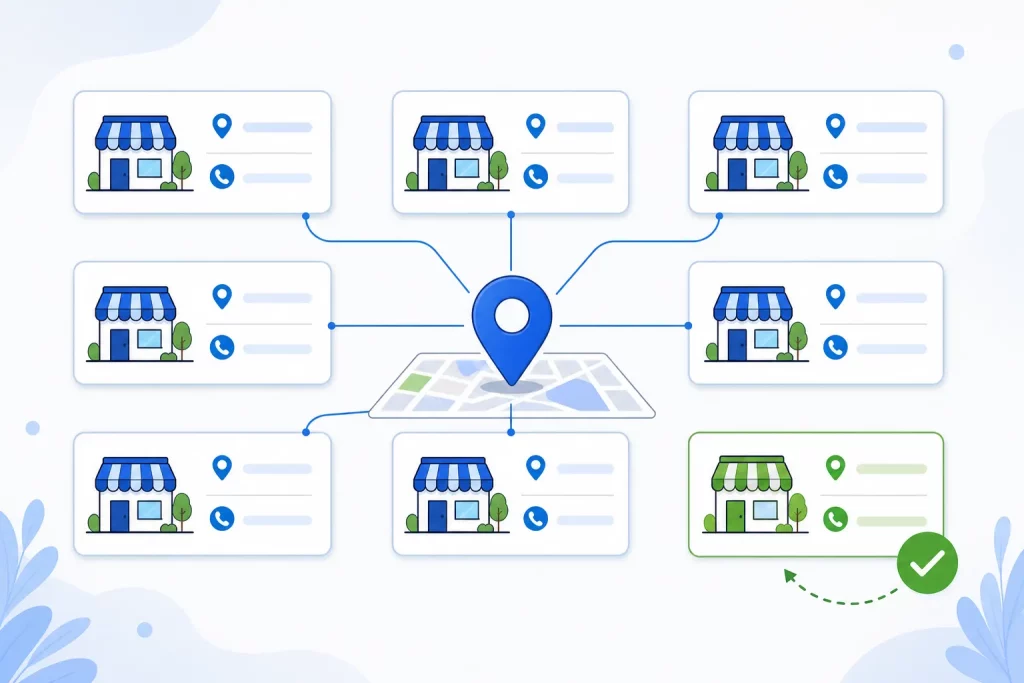
A local citation is any online mention of your business name, address and phone number, often shortened to NAP. Citations show up on directories, map apps, review sites, social profiles and local websites. NAP consistency means those details match everywhere, written the same way, so search engines, AI tools and customers all get the same answer about who you are and how to reach you.
Accurate, consistent citations help Google trust your business information. Messy ones send mixed signals and can create duplicate listings. This guide covers the types of citations, which ones matter, how they connect to rankings and AI answers, and a step-by-step way to find and fix NAP problems.
Structured vs. Unstructured Citations
Structured citations are listings with set fields for your name, address, phone, website, hours and category. Think business directories, map apps and review platforms. You usually create and control these yourself.
Unstructured citations are mentions in regular content: a local news story, a blog post, a chamber of commerce event page or a “best of” list. You don’t control the format, and many don’t include your full address. They still help show that real people and local sites know your business.
Both count. Structured citations are where consistency problems usually start, so they’re where most cleanup work happens.
Which Citations Matter Most
You don’t need hundreds of listings. Focus on the platforms that customers and search tools actually use:
- Google Business Profile. The most important listing for local search on Google Search and Maps.
- Apple Business Connect. Controls how you appear in Apple Maps and to Siri.
- Bing Places for Business. Feeds Bing and Microsoft’s search tools.
- Yelp. A major review platform and now a ChatGPT data source (more below).
- Facebook. Your business page carries NAP details many customers check.
- Industry directories. Sites specific to your trade, such as legal, medical or home service directories.
- Local directories. Chamber of commerce, city and regional business listings.
- Data aggregators. Companies that collect business data and pass it along to many directories, apps and navigation systems. Errors here can spread to dozens of sites.
Yelp deserves extra attention in 2026. In July, Search Engine Land reported that Yelp will feed real-time local data into ChatGPT, including reviews, photos and quote requests, with branded links back to Yelp. If your Yelp listing has an old phone number, ChatGPT users may now see it too.
How Citations Affect Local Rankings and AI Answers
Google’s local ranking help page says local results are based mainly on relevance, distance and prominence. On prominence, it says: “Prominence means how well-known a business is. Prominent places are more likely to show up in search results. This factor’s also based on info like how many websites link to your business and how many reviews you have.”
Google also explains how it sources business information. Profile information is compiled from several sources, including “crawled web content,” “licensed data from third parties,” and users who contribute factual information such as addresses and phone numbers. In other words, what other sites say about your business can feed what Google shows.
Its Business Profile guidelines add that Google “can also detect category information from your website and from mentions about your business throughout the web.”
The same logic applies to AI tools. ChatGPT, Gemini, Copilot and Siri each pull local facts from different places, so a wrong address on one platform can show up in one assistant’s answer and not another’s. Our guide to AI search optimization for local businesses breaks down which sources each tool uses.
How to Audit and Fix Your NAP: Step by Step
- Write down your official NAP. Pick one exact format for your business name, address (including suite number and abbreviations) and main phone number. Match it to your Google Business Profile and your website.
- Collect every old version. List past addresses, old phone numbers, tracking numbers and previous business names.
- Search for each version. Search Google for your business name, each old phone number and each old address. Note every listing that comes up.
- Check the core platforms by hand. Log in to Google, Apple Business Connect, Bing Places, Yelp and Facebook. Confirm name, address, phone, website, hours and category.
- Run a citation scan. Use a citation tool to find listings you missed, especially on smaller directories.
- Fix the listings you control. Claim each listing, then update it to your official NAP.
- Request fixes for the rest. For listings you can’t claim, use the site’s edit or support process.
- Fix the source. Correct your details with the data aggregators so bad data stops spreading.
- Recheck in a few weeks. Some sites update slowly, and some old data reappears. Keep a spreadsheet of each listing, its status and its login.
Duplicates and Old Listings
Duplicates are one of the most common citation problems. In our experience, conflicting old listings from an old address or phone number cause confusion and duplicate profiles. A customer finds the old number, can’t reach you, and calls a competitor. Meanwhile, search engines see two versions of the same business and aren’t sure which one is right.
Google’s guidelines are clear: “There should only be one profile per business.” If you find a duplicate Google profile, Google says you can suggest an edit or flag it for removal. On other directories, ask to merge or remove the duplicate rather than leaving both live. Moved recently? Update your citations at the same time you update your Google profile, not months later.
Citation Building vs. Citation Spam
Good citation building means creating accurate listings on platforms that are relevant to your business and location. A plumber in Indianapolis benefits from Google, Apple, Bing, Yelp, Facebook, a home services directory and the local chamber.
Citation spam looks different:
- Hundreds of listings on low-quality directories no customer visits.
- Keyword-stuffed business names, such as adding “Best Roofer Indianapolis” to your name. Google’s guidelines say including unnecessary information in your business name isn’t permitted and could result in suspension.
- Fake addresses or virtual offices used to appear in more cities.
- Different phone numbers or names on different sites to “test” results.
Accuracy beats volume. A short list of correct, relevant listings is worth more than a long list of messy ones.
Tools for Managing Citations
Several tools can help you find, track and update listings:
- BrightLocal
- Whitespark
- Yext
- Moz Local
Some scan for inconsistencies, some help you build new listings, and some push updates to many sites at once. Compare features against your needs before you commit. A tool can speed up the work, but someone still needs to check the results.
Citations are one part of a strong local presence. For the full picture, see our local SEO services, the local SEO checklist, our guide to Google Maps ranking factors, and how to choose the right Google Business Profile categories. Keeping your profile complete also matters: see how to maximize the reach of your Business Profile, what Business Profile optimization involves, and how reviews help rankings.
Frequently Asked Questions
What is a local citation?
A local citation is any online mention of your business name, address and phone number. It can be a directory listing, a map app profile, a review site page, a social profile or a mention in a local article.
What does NAP consistency mean?
NAP stands for name, address and phone number. NAP consistency means those details are written the same way on every listing and match your Google Business Profile and website.
Do citations still matter for local SEO?
Yes. Google says it compiles business information from sources that include crawled web content and licensed third-party data, and that prominence is based partly on how many websites link to your business. AI tools also pull business facts from listings such as Yelp, Bing Places and Apple Business Connect.
How many citations does my business need?
There’s no magic number. Start with Google, Apple Business Connect, Bing Places, Yelp and Facebook, then add the major directories for your industry and city. Accuracy matters more than volume.
How do I fix a listing with my old address or phone number?
Claim the listing if you can and update it to your current details. If you can’t claim it, use the site’s edit or support process. Then check the data aggregators so the old information stops spreading, and recheck in a few weeks.
Get Help Cleaning Up Your Listings
Local Blitz has helped local businesses fix their listings and grow in search since 2009, with offices in San Diego (Encinitas) and Indianapolis. If you’ve moved, changed numbers, or keep finding duplicate listings, book a free strategy call. We’ll show you where your NAP is out of sync. To plan budget, read our breakdown of local SEO cost. Our plans are month-to-month.
Is AI recommending your business?
We will ask ChatGPT, Gemini and Google AI about your business and show you what they say. It is free.
Want More Customers From Search?
Book a free strategy call, or call San Diego (858) 225-6877 or Indianapolis (317) 672-1156.