
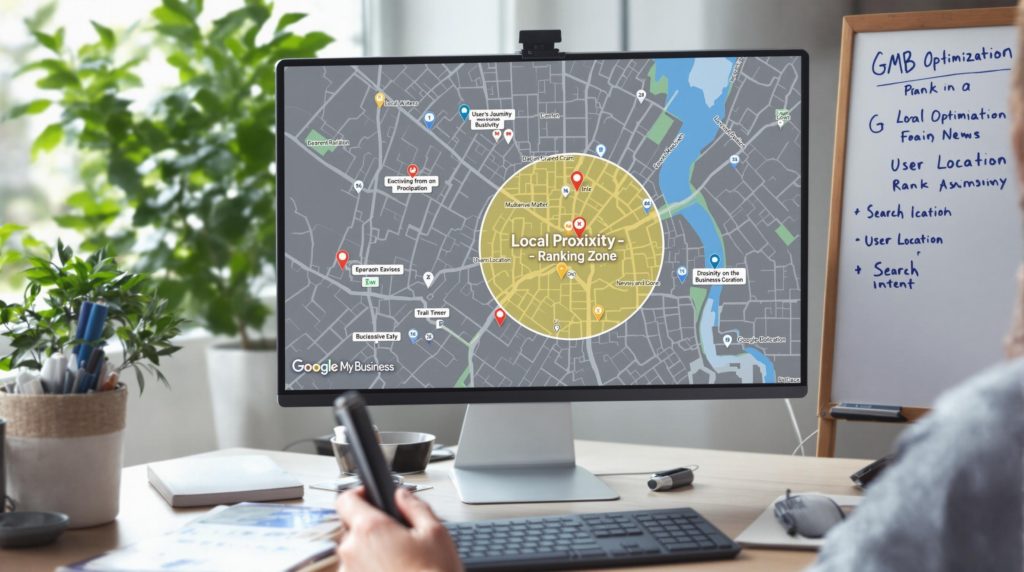
Proximity is how far your business is from the person searching, and Google lists it as one of the three main factors behind local rankings. It’s the one factor you can’t change. In our experience, a well-optimized profile in a medium to large city usually shows for searchers roughly 5 to 10 miles away. That range is smaller in dense cities and larger in small towns.
This guide explains what Google says about distance, how far a profile tends to reach, how service-area businesses fit in, and what you can do to compete for customers outside your natural radius.
What Google Says About Distance
Google’s help article Tips to improve your local ranking on Google says local results are “mainly based on relevance, distance, and popularity.” It describes the three factors this way:
- Relevance: how well a Business Profile matches what someone is searching for.
- Distance: “how far each business is from the customer who’s searching. If a customer doesn’t share where they are, Google uses what it knows about their location.”
- Prominence: how well known a business is, based on things like links to your business and how many reviews you have.
Google also says there is no way to request or pay for a better local ranking. In our experience, the primary category, proximity and reviews usually decide who makes the map pack. Our guide to Google Maps ranking factors covers the rest.
Why You Can’t Change Your Distance
Distance is measured from the searcher, not from you. The same profile ranks differently for someone across the street and someone across town, and you have no control over where people search from.
The tempting shortcut is a second address closer to the customers you want. Google’s guidelines for representing your business rule that out. P.O. boxes and remote mailboxes aren’t acceptable, and service-area businesses can’t list a “virtual” office unless it’s staffed during business hours. Google warns that breaking its guidelines can lead to your business information being changed or removed.
Real moves cause problems too. When you change address, old listings with the former address often stay online. In our experience, conflicting old listings are a common cause of duplicate profiles, which split your reviews and confuse Google about where you are. If you move, update your citations and NAP details everywhere.
How Far Does a Google Business Profile Reach?
For a well-optimized profile in a medium to large city, we usually see visibility for searchers roughly 5 to 10 miles away. In a dense urban area with many competitors, that shrinks. In a small town with few competitors, it can stretch much farther.
Reach also changes with the search itself. A “near me” search leans hard on the searcher’s location. A search that names a city, like “roofer in Carlsbad,” gives Google a location to work with, so businesses in or near that city have a better shot.
A Look Back at the Late-2021 Proximity Shift
In late 2021, we watched many clients’ profiles start showing for a tighter area around their address than before. Businesses that relied on the map pack for leads felt it. Google didn’t publish details, and the exact effect varied by market. The lesson still holds: Google can change how much distance counts at any time, so your reach is never fixed.
Service-Area Businesses and Proximity
If you travel to customers, like a plumber, cleaner or mobile mechanic, Google treats you as a service-area business. Its guidelines say you should have one profile for your central office or location, with a designated service area, and hide your address if customers don’t visit you there.
Google also sets a limit: your overall service area “shouldn’t extend farther than about 2 hours of driving time from where your business is based.” It notes that larger areas may be appropriate for some businesses.
In our experience, a hidden address still counts. Most local SEOs, us included, find that adding more towns to your service area doesn’t by itself make you rank in them. The service area tells customers where you work. Your ranking still starts from where your business is based.
How to Compete Beyond Your Radius
You can’t move closer to every customer, but you can make the other two factors as strong as possible. When relevance and prominence are strong, a profile tends to hold up farther from its address.
Strengthen Relevance
Pick the most accurate primary category (see our guide to Google Business Profile categories), list every service, and keep hours, photos and details complete. Google says complete and accurate information makes a profile more likely to show for relevant searches.
Build Prominence
Google names links and reviews as parts of prominence. Earn links and mentions from local news, associations and partners, and ask every customer for a review. Our guide on how Google reviews affect local rankings explains how to do that within Google’s rules.
Show Your Service Areas on Your Website
We’ve long recommended listing the areas you serve on the page your profile links to, usually the homepage. Then link from there to a useful page for each nearby city or neighborhood, with real details about the work you do there. Thin pages that only swap the city name don’t help.
Fill the Gaps With Organic Results and Ads
The regular results below the map are less tied to the searcher’s exact location, so strong city pages can win there even where your profile doesn’t show. Paid ads are another option, since you choose the areas they target.
Measure Your Reach With a Rank Grid
Checking your ranking from your own office tells you almost nothing, because you’re right next to the business. A rank grid tool checks the same search from many points spread across a map and shows your position at each one. You can see where you’re strong, where you drop off, and which competitors win each area.
Run the same grid for your main searches on a regular schedule and compare results over time. Rankings shift as Google refreshes its data, which we explain in how often Google Maps updates. For what to expect over time, see our realistic local SEO timeline. Our guide to maximizing the reach of your Google Business Profile covers more ways to grow it.
Frequently Asked Questions
How far away will my Google Business Profile show up?
In our experience, a well-optimized profile in a medium to large city usually shows for searchers roughly 5 to 10 miles away. The range is smaller in dense cities with many competitors and larger in small towns.
Can I rank in the map pack in a city where I don’t have an address?
Sometimes, if that city is close and your relevance and prominence are strong. It gets harder the farther the searcher is from your business. City pages on your website and regular organic results can help you reach customers in towns where your profile doesn’t show.
Does adding more service areas expand my reach?
Not on its own, in our experience. Service areas tell customers where you work, but rankings still start from where your business is based. Google also says a service area shouldn’t extend farther than about 2 hours of driving time from your base.
Should I get a virtual office to rank in another city?
No. Google’s guidelines don’t allow virtual offices unless they’re staffed during business hours, and P.O. boxes aren’t accepted. Breaking the guidelines can get your business information removed from Google. Only add a location where you have a real, staffed office.
Get Help Reaching More Local Customers
Local Blitz has been doing local SEO since 2009, with offices in San Diego (Encinitas) and Indianapolis. We work month-to-month, and we start every engagement by mapping where you show up today. Book a free strategy call to see your current reach and where you can grow it.
Is AI recommending your business?
We will ask ChatGPT, Gemini and Google AI about your business and show you what they say. It is free.
Want More Customers From Search?
Book a free strategy call, or call San Diego (858) 225-6877 or Indianapolis (317) 672-1156.