
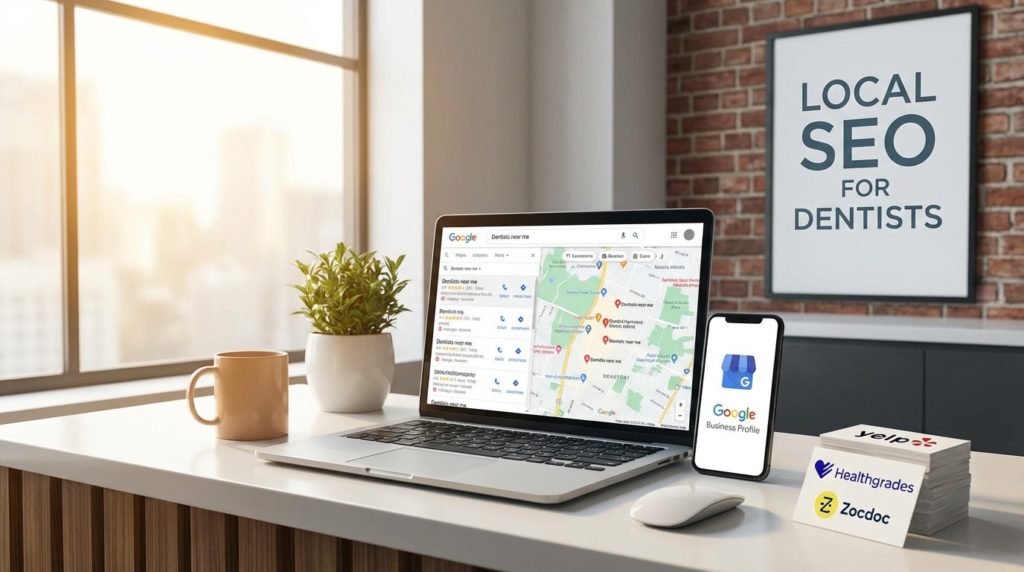
The digital transformation of healthcare has fundamentally altered how patients discover and select dental providers. With 97% of consumers searching online for local businesses and 46% of all Google searches seeking local information, establishing a dominant local online presence has become non-negotiable for dental practices. Local search optimization represents the most cost-effective patient acquisition strategy available to modern dental practitioners, enabling practices to capture high-intent prospects actively seeking dental services within specific geographic boundaries.
Unlike traditional advertising channels, local search visibility connects dental practices with prospective patients at the precise moment they express intent to schedule appointments. This comprehensive guide establishes authoritative strategies for maximizing location-based search performance, managing reputation marketing effectively, and converting proximity searches into consistent patient flow.
Google Business Profile Optimization Drives Dental Practice Visibility
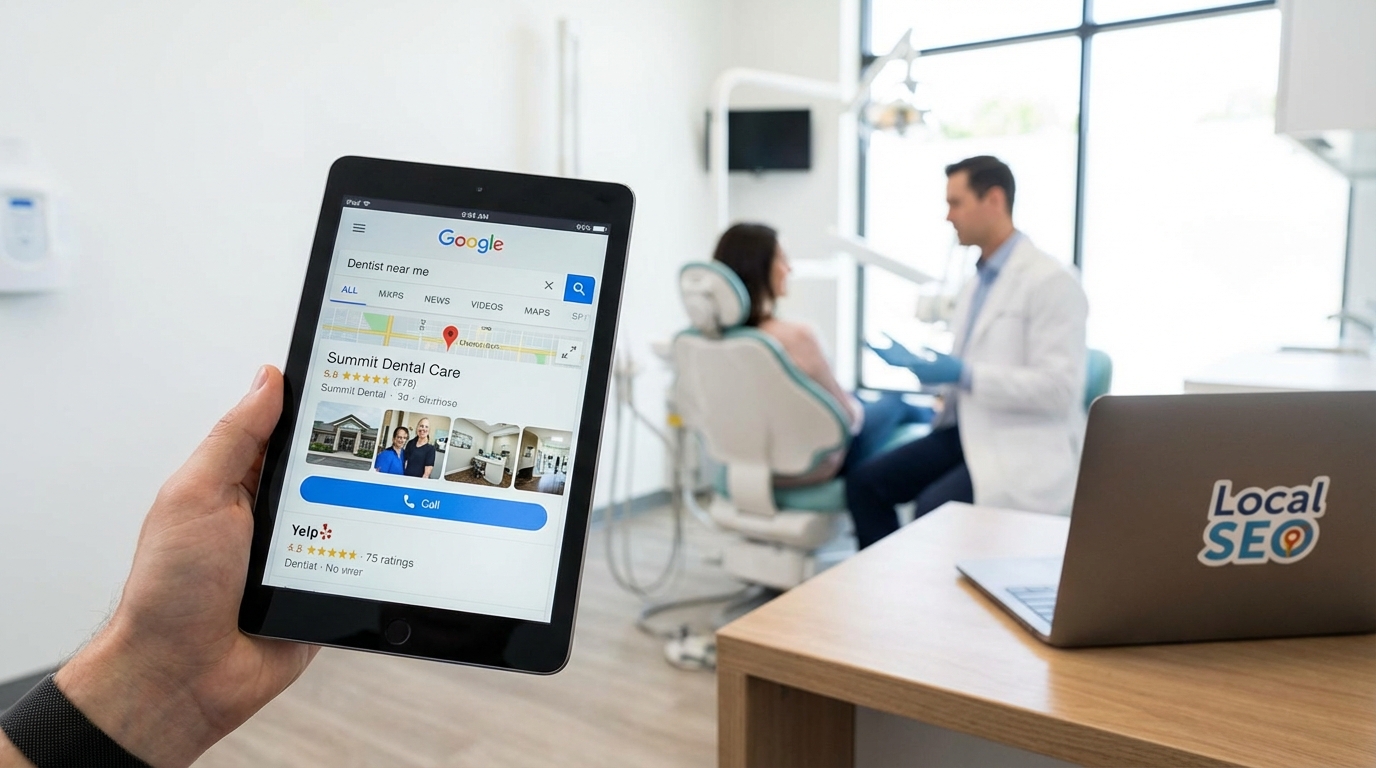
The Google Business Profile serves as the foundational element of any successful local dental SEO campaign. This free platform directly influences appearance in the Local Pack, Map Pack, and Knowledge Panel—the three primary visual real estate opportunities in search results. Dental practices with fully optimized profiles receive 7 times more clicks than incomplete listings and demonstrate significantly higher conversion rates for appointment booking.
How Does Complete Profile Information Impact Local Search Rankings?
Google's algorithm prioritizes comprehensive business information when determining local search rankings. Dental practices must meticulously complete every available field within their Google My Business dashboard, including business categories, service offerings, hours of operation, accepted insurance providers, and appointment URLs. Primary category selection proves particularly critical—selecting “Dentist” as the primary category while utilizing secondary categories like “Cosmetic dentist,” “Emergency dental service,” or “Pediatric dentist” expands visibility across specialized search queries.
Geographic precision significantly influences proximity search performance. Practices should specify exact service areas, ensuring coverage for all neighborhoods, suburbs, and communities within their patient acquisition radius. This geographic targeting directly impacts visibility for “dentist near me” searches, which now constitute 58% of all local dental searches on mobile devices.
Why Do Visual Assets Enhance Google Maps Ranking Performance?
Visual content generates 42% more direction requests and 35% higher click-through rates compared to profiles lacking imagery. Dental practices should maintain a minimum of 100 high-quality photographs showcasing office interiors, treatment rooms, staff members, technology investments, and before-after treatment results. Google explicitly confirms that businesses with photos receive more engagement, which subsequently improves ranking algorithms.
Professional video content further differentiates practices within competitive markets. Virtual office tours, dentist introductions, and procedure explanations build trust while increasing time-on-profile metrics—signals that Google interprets as relevance and quality indicators.
NAP Citations Establish Authority Across Dental Directory Listings
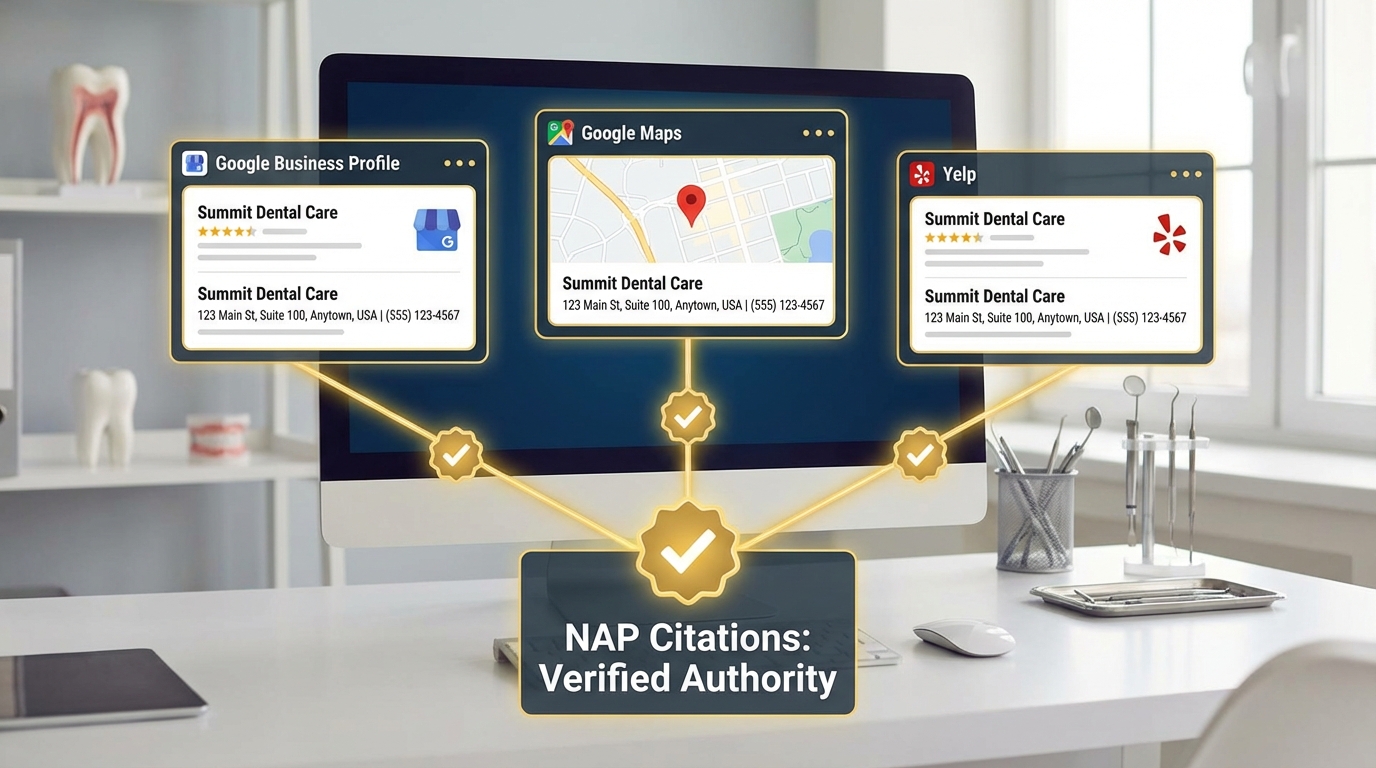
Name, Address, and Phone number consistency across the digital ecosystem forms the structural foundation of local search optimization. Search engines cross-reference NAP information across hundreds of platforms to verify business legitimacy and establish trust signals. Inconsistencies—even minor variations in suite numbers or phone formatting—dilute ranking potential and create algorithmic confusion.
Which Directory Submissions Matter Most for Dental Practices?
Strategic citation building prioritizes quality over quantity. Dental practices should establish presence on authoritative platforms that patients actually consult during provider research:
| Platform Category | Essential Directories | Impact Level |
|---|---|---|
| General Business | Bing Places, Apple Maps, MapQuest, Yellow Pages | High |
| Healthcare-Specific | Healthgrades, Zocdoc, WebMD, RateMDs, Vitals | Critical |
| Local Community | Better Business Bureau, Chamber of Commerce, Nextdoor | Medium-High |
| Professional Associations | American Dental Association, State dental boards | High |
Comprehensive citation management platforms like Moz Local, BrightLocal, and Yext automate distribution across hundreds of directories while monitoring NAP consistency. These services prove particularly valuable for multi-location dental practices requiring simultaneous management of multiple profiles.
How Does Schema Markup Enhance Search Engine Understanding?
Structured data implementation provides explicit context to search engines regarding business operations, services, and credentials. LocalBusiness schema and Dentist schema markup enable rich snippets, enhanced knowledge panels, and improved semantic understanding. Practices should implement schema identifying:
- Accepted payment methods and insurance providers
- Specific dental services offered (cosmetic dentistry, orthodontics, implants, periodontal treatment)
- Appointment booking functionality and emergency availability
- Professional credentials and American Dental Association membership
- Review aggregation displaying star ratings across platforms
Proper schema implementation creates competitive advantages in voice search optimization, where digital assistants increasingly rely on structured data for response formulation. As voice-activated “dentist near me” queries increase 58% annually, schema markup positions practices for next-generation search behaviors.
Patient Reviews Generate Trust Signals and Ranking Improvements

Online reputation management represents both a ranking factor and conversion driver within local search optimization. Google's algorithm explicitly incorporates review quantity, review velocity, star ratings, and review diversity when determining Local Pack placement. Practices averaging 4.0+ star ratings with consistent monthly review acquisition demonstrate 54% higher visibility compared to competitors with inferior reputation profiles.
What Systematic Approaches Optimize Review Generation?
Passive review collection yields insufficient volume for competitive markets. Dental practices require systematic review generation workflows incorporating multiple touchpoints:
- Post-appointment email sequences with direct review links to Google Business Profile, Facebook Business Page, and healthcare platforms
- SMS campaigns targeting patients following positive treatment experiences
- In-office tablet stations enabling immediate feedback collection
- Staff training emphasizing verbal review requests during checkout processes
- Review monitoring dashboards triggering immediate response protocols
Distribution across multiple platforms maximizes reach. While Google reviews directly influence Map Pack rankings, patient testimonials on Yelp, Healthgrades, and Zocdoc contribute to comprehensive reputation profiles that prospective patients evaluate during decision-making processes.
How Should Practices Manage Negative Review Response?
Negative feedback management tests practice professionalism while offering public demonstration of patient care commitment. Data indicates that 89% of consumers read business responses to reviews, with thoughtful responses to criticism improving brand perception. Effective negative review management follows specific protocols:
- Respond within 24 hours demonstrating attentiveness
- Acknowledge concerns without admitting liability or violating HIPAA regulations
- Offer offline resolution pathways through practice manager contact
- Maintain professional tone regardless of review validity
- Never argue publicly or provide defensive justifications
Strategic review response transforms negative experiences into competitive differentiators, showcasing commitment to patient satisfaction while humanizing practice operations.
Local Content Marketing Strengthens Geographic Relevance Signals
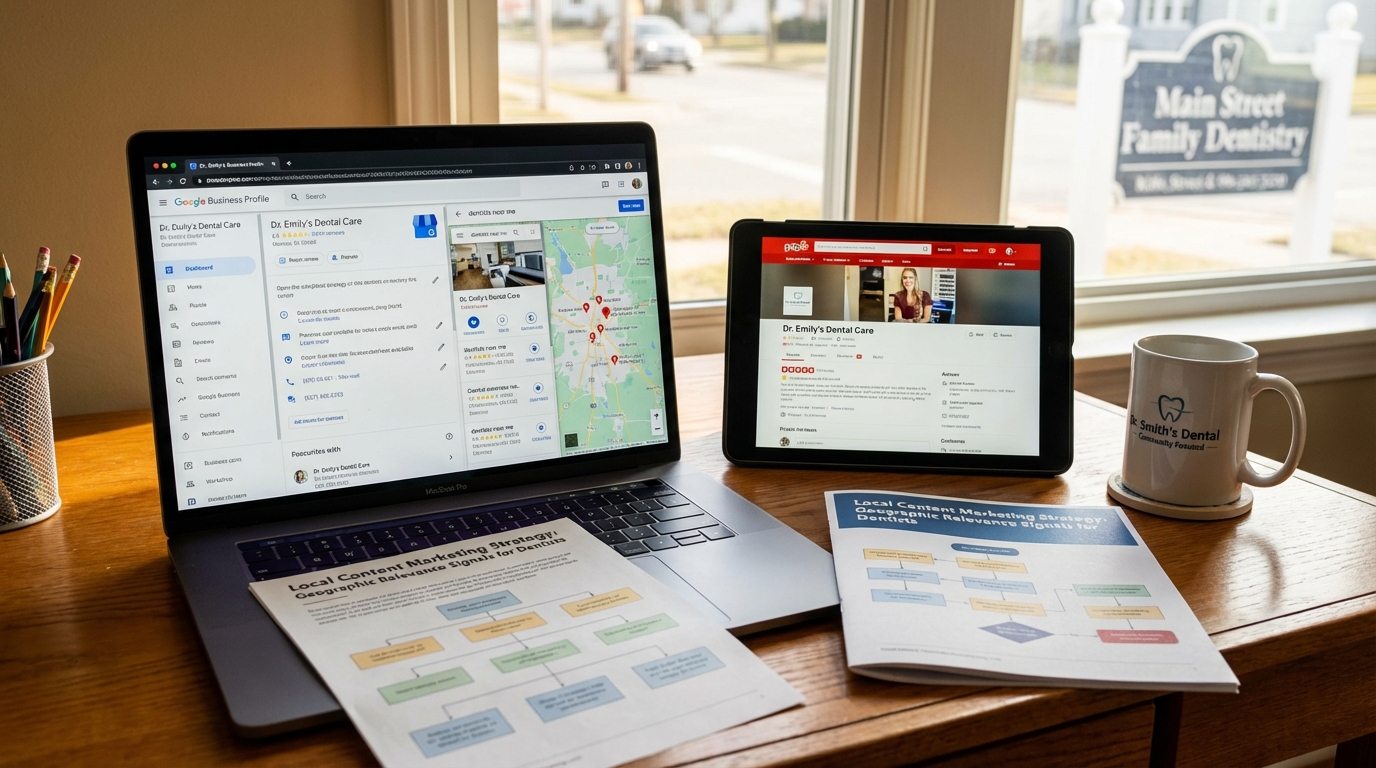
Dental website optimization extends beyond technical elements to encompass content strategies demonstrating community integration and local expertise. Location-specific content creation establishes topical authority while capturing long-tail search variations related to neighborhood dentistry and city dental services.
Which Content Formats Maximize Local Search Visibility?
Geo-targeted content strategy incorporates multiple formats addressing patient informational needs while reinforcing geographic targeting:
| Content Type | SEO Purpose | Implementation Example |
|---|---|---|
| Location Landing Pages | Target city-level SEO queries | “Family Dentistry in [City Name]” |
| Service-Specific Pages | Capture specialty procedure searches | “Dental Implants in [Neighborhood]” |
| Community Involvement Content | Build local backlinks and relevance | Sponsorship announcements, charity participation |
| Local Resource Guides | Establish authority and engagement | “Maintaining Oral Health in [City Climate]” |
Each location page requires unique content avoiding duplication penalties. Multi-location dental practices must develop distinct narratives for each office incorporating neighborhood-specific details, local landmarks, parking information, and community connections.
How Do Local Backlinks Influence Domain Authority?
Local link acquisition from community organizations, news publications, and complementary healthcare providers signals geographic relevance while building domain authority. Strategic local PR initiatives—including community event sponsorship, educational workshop hosting, and expert commentary for local media—generate high-quality backlinks that search engines weight heavily in ranking algorithms.
Partnership development with local schools, sports organizations, and charitable foundations creates natural backlink opportunities while strengthening community integration. These relationships generate sustainable link equity unavailable through generic link building approaches.
Performance Measurement Through Analytics Platforms Enables Optimization
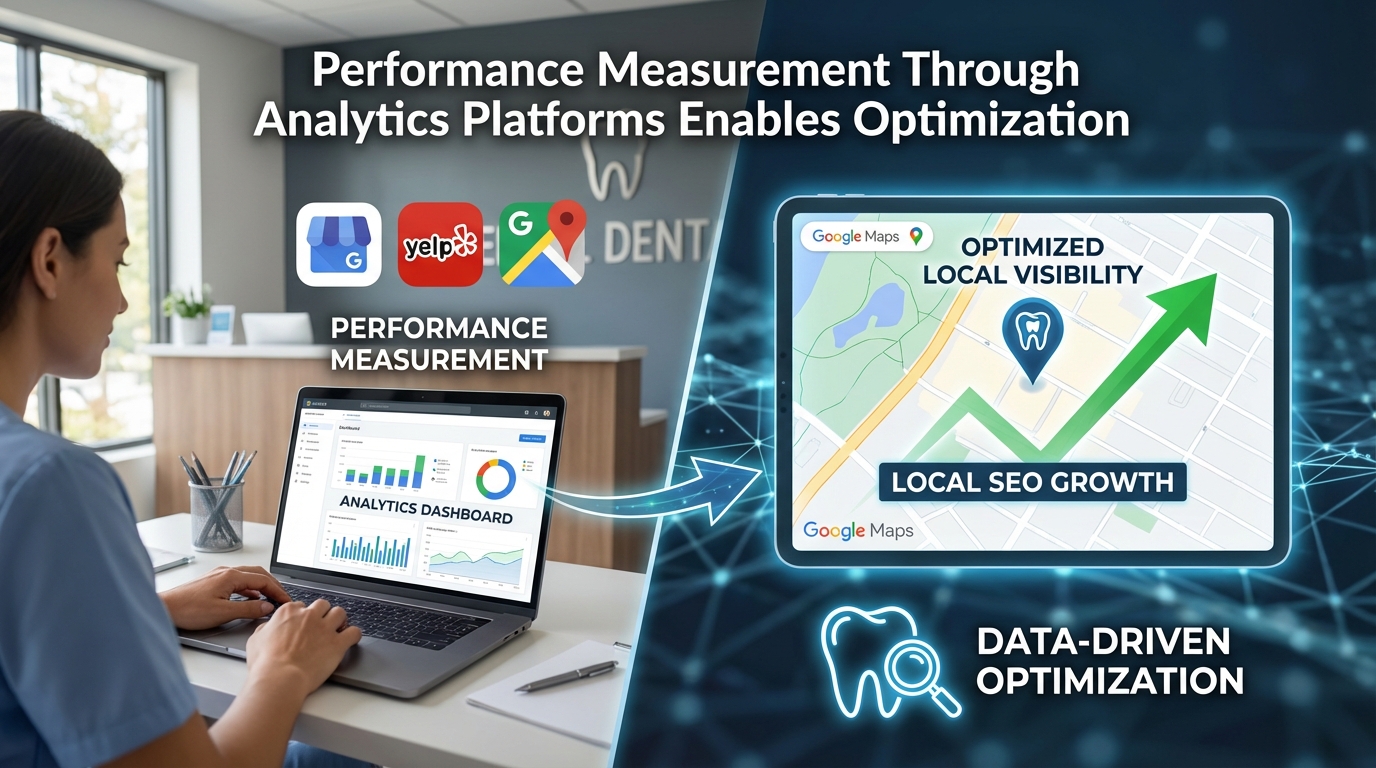
Data-driven local SEO requires systematic performance tracking across multiple platforms. Google Search Console and Google Analytics provide foundational insights regarding search query performance, geographic traffic sources, and user behavior patterns. Specialized local SEO platforms including SEMrush, Ahrefs, and Whitespark offer competitive intelligence, ranking tracking, and citation monitoring capabilities.
What Key Performance Indicators Determine Success?
Dental practices should monitor specific metrics indicating local search performance and patient acquisition effectiveness:
- Local Pack appearance frequency for priority keywords
- Google Maps ranking position within service area radius
- Direction requests and phone call volume from Google Business Profile
- Organic traffic from location-specific search queries
- Appointment booking conversion rates from local channels
- Review acquisition velocity and average star ratings across platforms
Monthly competitive analysis benchmarking performance against local competitors identifies opportunity gaps and validates strategic investments. Market analysis examining competitor review profiles, content strategies, and citation footprints informs tactical adjustments maximizing dental practice growth potential.
Frequently Asked Questions
How long does local SEO take to show results for dental practices?
Local SEO for dental practices typically demonstrates measurable improvements within 3-6 months of consistent implementation. Google Business Profile optimization and citation building produce the fastest results, often generating visibility improvements within 30-60 days. More competitive ranking achievements, particularly for high-value keywords in saturated markets, require 6-12 months of sustained effort including content development, review generation, and backlink acquisition. Practices in smaller markets with limited competition frequently achieve Local Pack placement within 90 days.
What is the most important ranking factor for dentist local SEO?
Google Business Profile optimization represents the single most impactful ranking factor for local dental search visibility. Complete profile information, regular posting activity, high-quality visual content, and consistent positive reviews directly influence Local Pack and Google Maps rankings. However, sustainable local SEO success requires balanced attention across multiple factors including NAP citation consistency, on-page website optimization with location-specific content, review quantity and quality, and local backlink acquisition from community sources.
Should dental practices focus on Google reviews or healthcare-specific platforms?
Dental practices should prioritize Google reviews for direct ranking impact while simultaneously maintaining presence on healthcare-specific platforms including Healthgrades, Zocdoc, and Vitals. Google reviews directly influence Local Pack placement and Google Maps rankings, making them the primary focus for review generation campaigns. However, patients frequently consult multiple platforms during provider research, with healthcare directories offering specialized filtering by insurance, specialty, and appointment availability. A comprehensive reputation management strategy distributes review acquisition across both general and healthcare-specific platforms.
How many citations does a dental practice need for effective local SEO?
Citation quantity requirements vary based on market competitiveness. Dental practices in moderately competitive markets should establish presence on 40-60 authoritative directories, with emphasis on major platforms including Google Business Profile, Bing Places, Apple Maps, and healthcare directories like Healthgrades and Zocdoc. Highly competitive metropolitan markets may require 80-100+ citations for optimal positioning. Citation quality supersedes quantity—prioritize authoritative, relevant directories over mass submission to low-quality aggregators. Consistency across citations proves more important than sheer volume, as contradictory NAP information undermines all citation value.
Can dental practices with multiple locations use the same website?
Multi-location dental practices should utilize a single primary website with dedicated location-specific landing pages for each office. This structure consolidates domain authority while providing unique content targeting each service area's geographic search queries. Each location page requires distinct content incorporating neighborhood details, office-specific staff information, local landmarks, and unique patient testimonials. Separate Google Business Profiles must be created for each physical location, all linking to their respective location pages. This approach optimizes both user experience and search engine understanding while avoiding duplicate content penalties.
Is paid advertising necessary alongside local SEO for dental practices?
Paid advertising complements but does not replace local SEO for sustainable dental practice growth. Local SEO generates ongoing organic visibility without per-click costs, providing superior long-term return on investment. However, new practices lacking established online presence benefit from temporary paid campaigns on Google Ads and Facebook to generate immediate patient flow while local SEO efforts mature. Established practices may utilize selective paid advertising for competitive specialty services like cosmetic dentistry or dental implants where organic competition proves intense. The optimal strategy combines strong local SEO foundations with strategic paid advertising for specific objectives.