
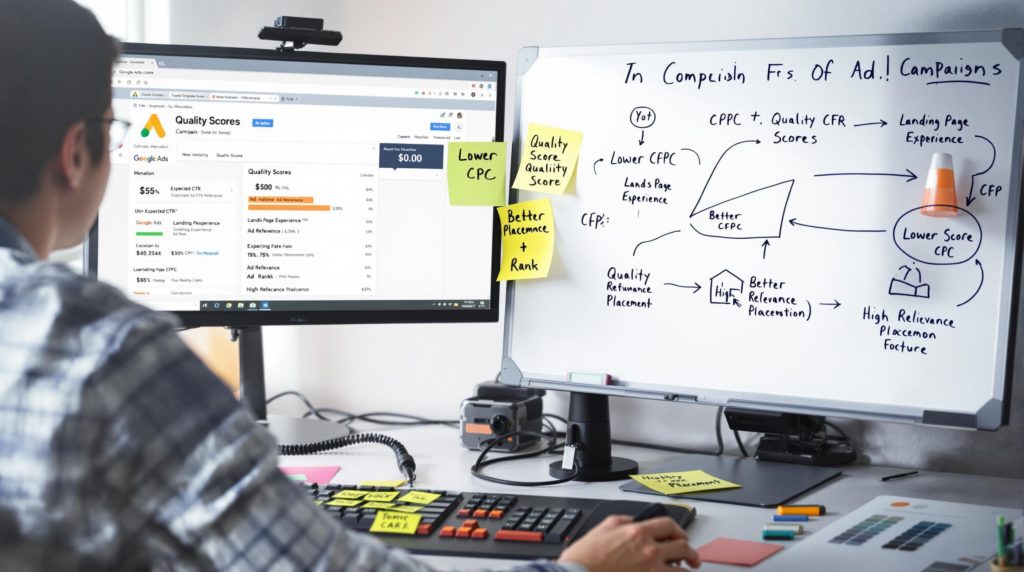
Google Ads Quality Score is a 1 to 10 rating, shown for each keyword, that tells you how your ad quality compares with other advertisers. It’s built from three components: expected clickthrough rate, ad relevance and landing page experience. Google describes it as a diagnostic tool, and says plainly that Quality Score is not an input in the ad auction. It matters because it shows you where your ads, keywords and landing pages are weaker than the competition, which are the same areas the auction looks at.
An earlier version of this article treated Quality Score as something Google uses directly to set your costs and reach. Google’s current help pages explain it differently, so we’ve rewritten it. For more on how campaigns are run, see our Google Ads hub.
What Quality Score Measures
According to Google’s About Quality Score page, the score is a gauge of how well your ad quality stacks up against other advertisers who showed ads for the same searches. It’s available at the keyword level, so a campaign can have keywords scoring a 3 next to keywords scoring an 8.
Sometimes the column shows a dash instead of a number. Google explains that this happens when there aren’t enough searches that exactly match your keyword to calculate a score. It’s common for low-volume local keywords.
The Three Quality Score Components
Each component is rated Above average, Average or Below average. Google bases the rating on a comparison with other advertisers whose ads showed for the exact same search over the last 90 days.
| Component | What it measures | Where to look if it’s low |
|---|---|---|
| Expected clickthrough rate (CTR) | How likely your ad is to be clicked when it shows | Ad headlines and descriptions, the offer, the call to action |
| Ad relevance | How closely your ad matches the intent behind the search | Ad group structure and how well ad text matches the keywords |
| Landing page experience | How relevant and useful your landing page is to people who click | The page the ad sends people to |
Expected Clickthrough Rate
This is a prediction of whether people will click your ad for that keyword. A Below average rating usually means the ad doesn’t feel like a direct answer to the search. Google’s advice is to make the offer more appealing, be more specific in your ad text, and use a call to action that fits your landing page. It also notes that more specific ads can get fewer clicks but more conversions, which for a local business is usually a good trade.
Ad Relevance
This checks how well the ad lines up with what the person typed. The usual cause of a low rating is an ad group holding too many loosely related keywords, so one ad has to cover them all. Google suggests matching your ad language more directly to the search terms, splitting loosely related keywords into separate ad groups, and grouping keywords by theme, such as by product or service.
Landing Page Experience
This looks at what happens after the click. Google’s guidance is to give people what they’re looking for, keep the message on the page consistent with the ad, make the site mobile-friendly and improve loading speed. Sending every ad to your homepage is one of the most common reasons this rating comes back low. Our guide to Google Ads landing pages goes into detail.
Quality Score vs Ad Rank
This is the part most older articles get wrong. Ad Rank decides whether your ad can show and where it appears. Google says Ad Rank is based on your bid, the quality of your ads and landing page, Ad Rank thresholds, the competitiveness of the auction, the context of the search, and the expected impact of assets and other ad formats.
The quality part of Ad Rank isn’t your Quality Score. Google uses auction-time measurements of expected CTR, ad relevance and landing page experience, worked out fresh for each search with that search’s context. Quality Score is a summary of how you’ve been doing in those same areas. So the two are related, but the number in your account is not plugged into the auction.
| Quality Score | Ad Rank | |
|---|---|---|
| What it is | A 1 to 10 diagnostic rating per keyword | A set of values calculated for each auction |
| Used in the auction? | No | Yes, it decides eligibility and position |
| Can you see it? | Yes, in your keyword columns | No, it isn’t reported as a number |
| Updates | Based on recent performance on exact-match searches | Every time someone searches |
For the full walk-through of the auction, read how Google Ads works.
Why Quality Score Still Matters
If it isn’t part of the auction, why look at it at all? Because it’s one of the few places Google tells you how your ads compare with competitors on relevance and user experience. Google says higher quality ads can often lead to lower costs per click, and that a highly relevant ad can win a higher position at a lower price. Quality Score is the quickest way to spot which keywords, ads or pages are holding that back.
What it isn’t is a goal. Google calls it a general indicator of which areas to focus on, rather than a score to be optimized. A keyword with a 5 that brings in steady calls at a cost you’re happy with is doing its job. A keyword with a 9 that never converts isn’t.
How to Improve Your Quality Score
Google’s article on using Quality Score to improve performance lists five approaches. Here’s how they look in a local business account:
- Review the components first. Add the expected CTR, ad relevance and landing page experience columns to your keyword view. A low score with one Below average component tells you exactly where to work.
- Make ads more relevant to keywords. Split ad groups by service. “Water heater repair” and “drain cleaning” should not share one ad.
- Improve clickthrough rate. Put the service and the location in the headline, state a clear offer, and use assets such as call and location details where they fit.
- Update the landing page. Send each ad group to a page about that service, with the phone number and a short form easy to find on mobile.
- Use Quality Score with other metrics. Judge keywords by conversions and cost per lead as well. Quality Score is context, not the verdict.
Match Types and Negative Keywords
Google notes that match type doesn’t change the Quality Score itself, because the score is based on searches that exactly match your keyword. Match types and negatives still matter for the searches you pay for. A tidy negative keyword list stops ads showing for searches that were never going to convert, which helps your clickthrough rate on the searches that do count. See broad match vs exact match keywords for how match types work now.
Common Quality Score Problems We See
When we look at accounts that local businesses have run themselves or inherited from another provider, the same patterns come up:
- Every ad points to the homepage. The page doesn’t mention the specific service, so landing page experience suffers.
- One ad group for the whole business. Dozens of unrelated keywords share a single generic ad.
- No negative keywords. Ads show for job searches, DIY questions and services the business doesn’t offer.
- Chasing the number. Time spent nudging a score from 7 to 8 while conversion tracking is broken.
- Slow mobile pages. Most local searches happen on phones, and a page that loads slowly or hides the phone number loses people.
Fixing these usually starts with tracking. Without it you can’t tell which keywords are worth improving. Our guide on tracking ad performance for a service-based business covers calls, forms and bookings.
Quality Score and Your Budget
Better ads and pages don’t only help position. When ads are relevant and pages convert, more of each day’s budget turns into leads instead of wasted clicks. If you’re still working out how much to spend, read what to budget for Google Ads campaigns. And because a strong landing page helps organic search too, the work often supports your SEO as well. We explain that overlap in how PPC and SEO work together.
Frequently Asked Questions
What is a good Quality Score in Google Ads?
Google doesn’t set a target. It rates each component as Above average, Average or Below average against advertisers who showed for the same searches. Rather than aiming for a number, look for components rated Below average on keywords that get real traffic, and fix those first.
Does Quality Score affect what I pay per click?
Not directly, because Google says Quality Score is not an input in the ad auction. The auction uses its own auction-time measures of expected clickthrough rate, ad relevance and landing page experience, and Google says higher quality ads can often lead to lower costs per click. Quality Score shows you how you’re doing in those same areas.
Why does my keyword show a dash instead of a Quality Score?
Google shows a dash when there aren’t enough searches that exactly match the keyword to calculate a score. This is common for low-volume local keywords and isn’t a problem in itself.
Does changing a keyword’s match type change its Quality Score?
No. Google says match type doesn’t change the score, because Quality Score is based on searches that exactly match the keyword. Broadening a match type can let a keyword enter more auctions, which can help it gather enough data to get a score.
Which Quality Score component should I fix first?
Start with any component rated Below average on your highest-traffic keywords. Landing page experience is often the biggest gap for local businesses, because many send every ad to the homepage instead of a page about the specific service.
Get Help Improving Your Google Ads
Local Blitz has been in business since 2009, with offices in San Diego (Encinitas) and Indianapolis. When we take on a Google Ads account, we look at structure, keywords, landing pages and tracking together, and we report on the calls and leads the campaigns bring in. There are no cookie-cutter packages, plans are month-to-month, and ad spend is paid directly to Google, separate from our management fee. See our pricing page for how that works, or book a free strategy call and we’ll tell you what we’d change first.
Is AI recommending your business?
We will ask ChatGPT, Gemini and Google AI about your business and show you what they say. It is free.
Want More Customers From Search?
Book a free strategy call, or call San Diego (858) 225-6877 or Indianapolis (317) 672-1156.