
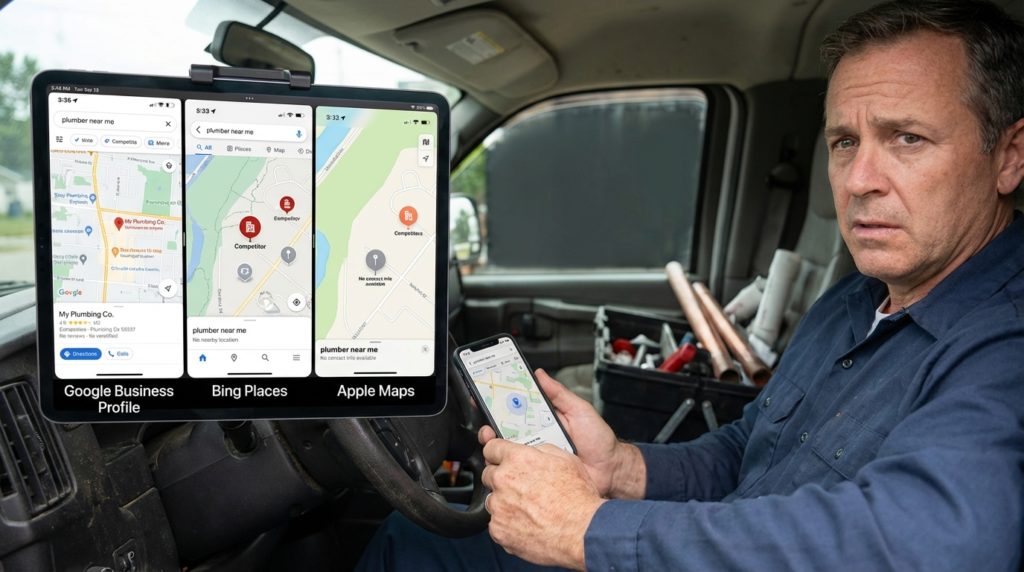
Your plumbing company is losing business to competitors who appear first in “emergency plumber near me” and “24 hour plumber” searches. This visibility gap directly impacts customer acquisition and your marketing budget efficiency. Local SEO for plumbers is fundamentally different from general SEO because service area businesses depend on proximity, relevance, and prominence signals that Google Maps and local algorithms prioritize.
You're Experiencing This If…
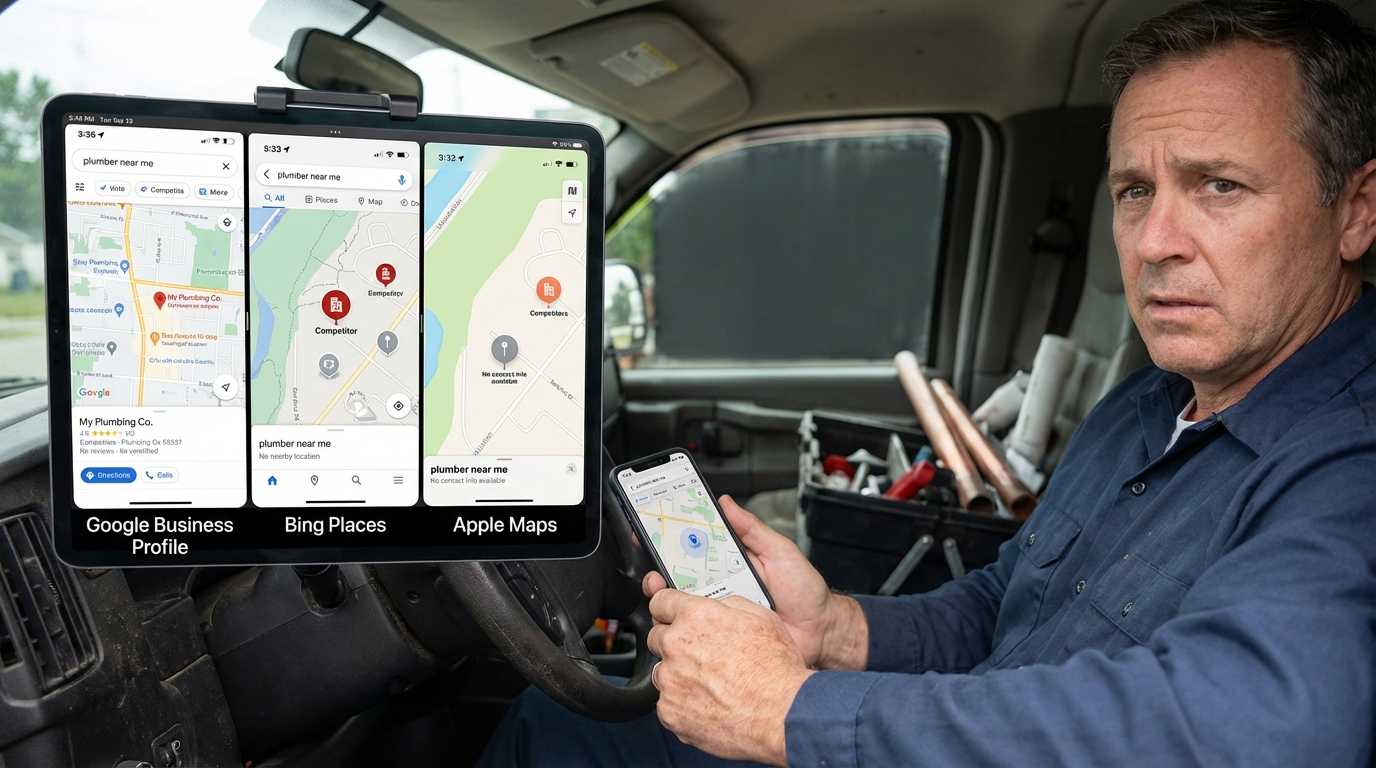
Your Google Business Profile receives minimal impressions despite being listed. Your website traffic from organic search remains flat despite months of effort. Competitors rank higher in the Local Pack (Map Pack) even though your service area and qualifications match theirs. You receive fewer plumbing leads from online channels compared to word-of-mouth referrals. Your click-to-call and conversion rate metrics are below industry benchmarks for contractors.
A master plumber or journeyman plumber operating a residential plumbing business should generate 40-60% of new leads from local online visibility. If you're generating less than 25%, your local SEO strategy requires immediate intervention across your Google Business Profile, citations, and on-page optimization.
Quick Solution: Optimize Your Google Business Profile Now
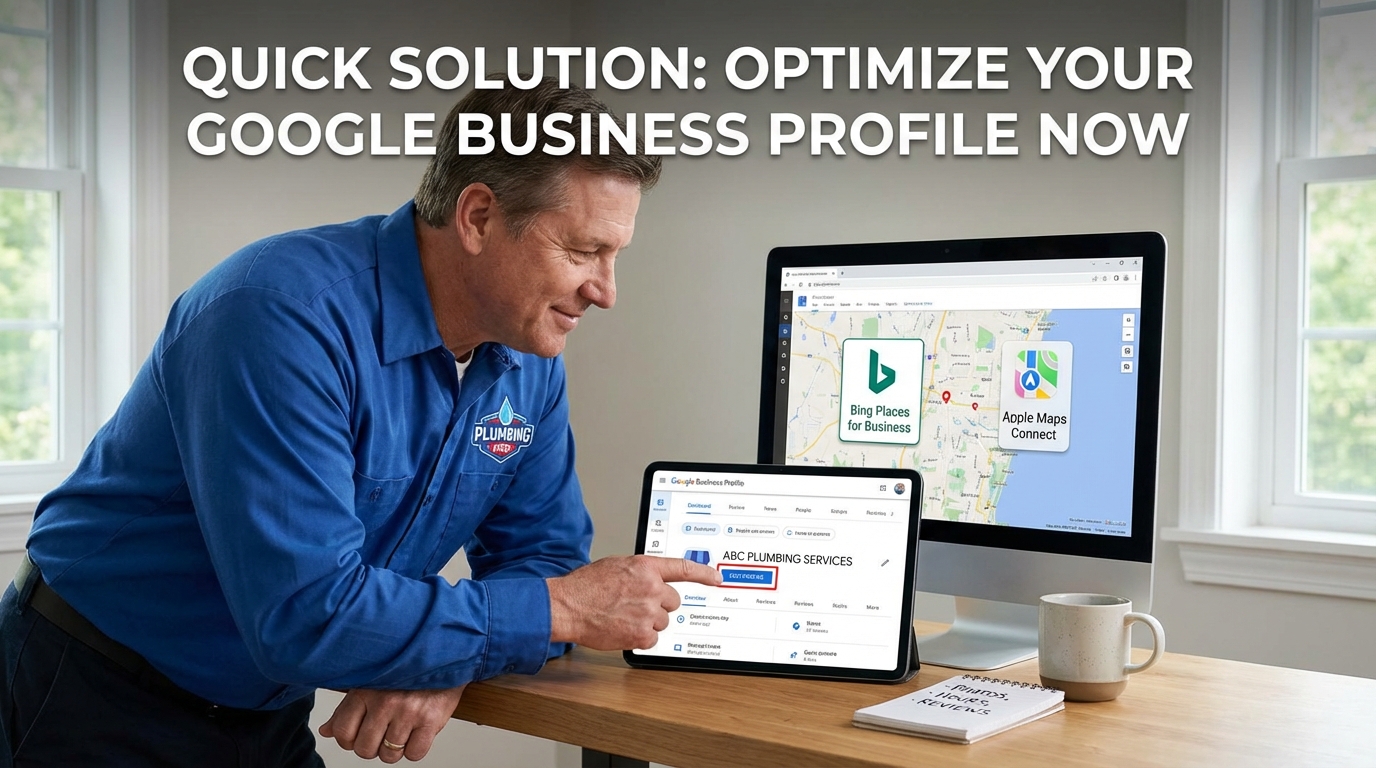
The fastest path to local visibility is maximizing your Google Business Profile (formerly Google My Business). This is the single most important factor in local algorithm rankings for service area businesses like plumbing contractors.
Action steps (15 minutes):
- Claim and verify your Google Business Profile for your primary service location
- Add service area coverage (specify neighborhoods, cities, and ZIP codes you serve)
- Upload high-quality photos of your team, vehicles, and completed bathroom remodeling or kitchen remodeling projects
- Fill all business categories: “Plumber,” “Emergency Plumber,” “Licensed Plumber” where applicable
- Add a local phone number with click-to-call enabled
- Write a 150-word business description targeting “affordable plumbing,” “plumbing repair,” and other service keywords
Result: Most plumbers see a 25-40% increase in map impressions within 2-3 weeks after completing these steps.
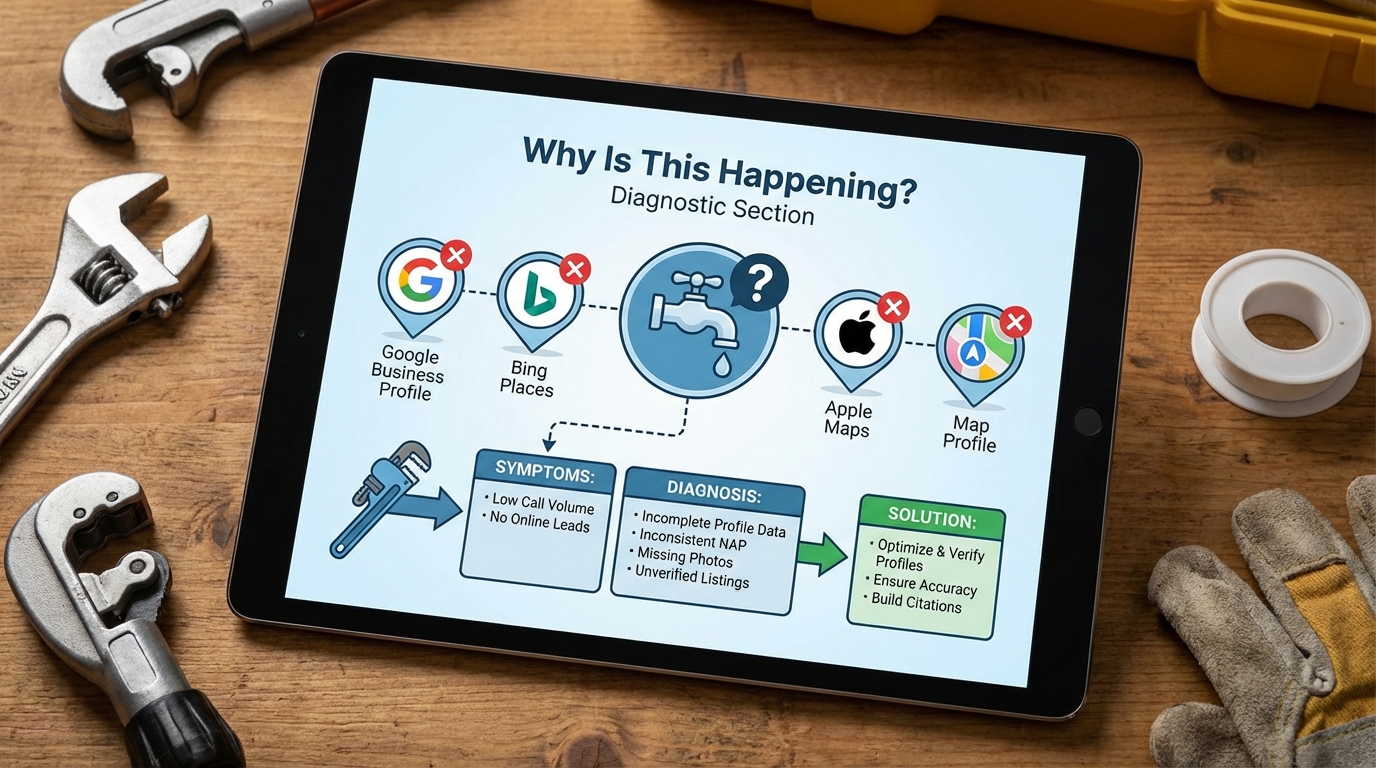
Why Is This Happening? Diagnostic Section
The Local Algorithm's Three Pillars
Google's local algorithm relies on three factors: proximity (how close your business is to the search location), relevance (how well your content matches search intent for plumbing leads), and prominence (your authority and reputation signals including reviews and testimonials).
Most plumbers fail because they neglect at least one pillar. Your Google Business Profile might be incomplete (weak prominence). Your website pages don't mention your service area by name (weak relevance). Your NAP Consistency—Name, Address, Phone—is incorrect across business directories like Yelp, HomeAdvisor, Angi, and Thumbtack (weak proximity and trust signals).
Common Local SEO Mistakes for Contractors
- Duplicate listings: Your business appears 3-5 times on Google Maps with different information, confusing the algorithm and splitting review signals
- Missing citations: You're not listed on Yelp, Better Business Bureau, Bing Places, or Apple Maps, reducing your digital footprint
- Inconsistent NAP data: Your address format differs between your website homepage and your Google Business Profile; phone number formatting varies; business name includes or excludes abbreviations inconsistently
- Poor review management: You have fewer than 20 verified customer reviews, or your average rating is below 4.2 stars
- Weak on-page optimization: Your homepage and service pages don't target geo-specific keywords like “plumbing repair in [City Name]” or “emergency plumber near me”
- Slow mobile experience: Your site speed metrics fail mobile tests; user experience is poor on smartphones
Solution #1: Fix NAP Consistency Across All Citations
NAP Consistency is the foundation of local SEO for any contractor. Your business name, address, and phone must be identical across every online location where it appears.
Step-by-step process:
- Audit all current citations using SEMrush, Ahrefs, or BrightLocal's audit tools
- Document your canonical NAP: exact legal business name, complete address with ZIP code, primary phone number with formatting
- Update your Google Business Profile, Google Maps listing, and Google Search Console first
- Claim and correct profiles on: Yelp, HomeAdvisor, Angi, Thumbtack, Better Business Bureau, Bing Places, Apple Maps, and Facebook
- Verify consistent formatting: “Main Street” vs “Main St,” “(123) 456-7890” vs “123-456-7890”
- Update your WordPress website header/footer with matching contact information
Use local citation services like Whitespark or BrightLocal to submit your corrected NAP to data aggregators simultaneously, ensuring propagation across hundreds of directories within 30-60 days.
Solution #2: Build a Review Management Strategy
Online reviews directly influence local algorithm rankings. Google Maps prioritizes businesses with more reviews, higher ratings, and recent feedback. Your 5-star rating and customer testimonials are prominence signals that beat competitors with fewer reviews.
Implement these tactics:
- Ask every residential plumbing customer for a review within 24 hours of job completion (email + SMS preferred)
- Generate 3-5 new reviews monthly to maintain freshness signals
- Respond to all reviews—positive and negative—within 48 hours with professional, specific replies
- Use JSON-LD schema markup on your website to display reviews and aggregate ratings (increases click-through rate by 15-25%)
- Never use review gating (requiring customers to rate before feedback); this violates Google's policies and triggers penalties
- Monitor HomeAdvisor, Angi, and Thumbtack reviews alongside Google and Yelp
Plumbers with 30+ reviews and a 4.5+ star average rank 2-3 positions higher in the Local Pack compared to those with 10 reviews.
Solution #3: Submit Citations to Business Directories and Data Aggregators
Beyond Google Business Profile, your plumbing company needs presence on high-authority business directories. Citations build domain authority and amplify your proximity signals across the local ecosystem.
Priority directories for service area businesses:
| Directory | Authority Level | Plumbing-Specific | Citation Building Priority |
|---|---|---|---|
| Yelp | High | Yes | Tier 1 (must have) |
| HomeAdvisor | High | Yes | Tier 1 (essential for leads) |
| Angi | High | Yes | Tier 1 (essential for leads) |
| Thumbtack | Medium-High | Yes | Tier 1 (customer acquisition) |
| Better Business Bureau | High | No | Tier 2 (trust signals) |
| High | No | Tier 2 (social integration) | |
| Nextdoor | Medium | No | Tier 2 (hyperlocal reach) |
| High | No | Tier 3 (brand authority) |
Local citation services automate this process. BrightLocal, Whitespark, and Moz Local submit your corrected NAP to hundreds of platforms simultaneously, reducing manual work by 80%.
Solution #4: Optimize On-Page Content for Service Area and Keywords
Your website content must target geo-specific keywords and answer search intent for plumbing searches. Most plumber websites lack location pages and keyword-optimized content.
Content optimization checklist:
- Homepage: Include primary keyword “plumber” + city name within first 100 words; meta tags optimized for “emergency plumber near me”
- Service pages: Create dedicated pages for each service (plumbing repair, bathroom remodeling, kitchen remodeling) with location modifiers
- Service area pages: Build individual pages for each city/neighborhood you serve; optimize anchor text and internal linking
- Schema.org markup: Add LocalBusiness schema to homepage; Service schema to service pages
- Alt text: Describe images with location + service keywords; improves accessibility and SEO
- Keyword density: Target 1-2% density for primary keywords; 0.5-1% for secondary LSI keywords like “affordable plumbing,” “24 hour plumber”
Use Yoast SEO or RankMath plugins (WordPress) to automate on-page optimization recommendations. Screaming Frog audits your site structure and identifies missing meta tags across all pages.
Solution #5: Improve Technical SEO and Site Speed
Mobile-friendly design and fast page speed directly impact your local algorithm rank and conversion rate. Google prioritizes responsive websites that load under 2 seconds.
Technical SEO fixes:
- Verify mobile responsiveness using Google Mobile-Friendly Test
- Reduce image file sizes; enable lazy loading for faster initial page load
- Minimize CSS/JavaScript files; enable browser caching
- Implement SSL certificate (HTTPS) across all pages
- Fix crawl errors in Google Search Console; submit XML sitemaps
- Remove duplicate content and consolidate similar pages
- Optimize Core Web Vitals (Largest Contentful Paint, First Input Delay, Cumulative Layout Shift)
Use Google Analytics to monitor bounce rate and user engagement; high bounce rates (above 60%) signal poor user experience and hurt rankings. Ahrefs and SEMrush provide site audit reports identifying technical issues by priority.
Solution #6: Dominate Google Maps Rankings with Proximity Optimization
Google Maps algorithm weights proximity heavily for service area businesses. The closer your office location to search coordinates, the higher you rank in the Map Pack.
Strategies to improve map visibility:
- Ensure service area coverage is defined in Google Business Profile; list all cities and ZIP codes
- Add location-specific posts monthly (“Now serving Downtown [City],” “Emergency response in [Neighborhood]”)
- Use call tracking to monitor which geographic areas generate the most qualified plumbing leads
- Build local backlinks from neighborhood association websites, city directories, and local news
- Create content targeting “near me searches” (80% of local searches use this modifier)
- Maintain fresh business information; outdated hours or services signal abandonment
Plumbers with optimized service area coverage see 30-50% more map impressions compared to those with generic coverage.
Advanced: Local Link Building and Content Marketing for Trades
Backlinks remain a critical ranking factor. For contractors, local link building focuses on high-authority, geographically relevant sources.
Content marketing strategy:
- Write blog posts targeting informational keywords: “How to Fix a Leaky Faucet,” “Signs You Need a Master Plumber,” “Emergency Plumber vs DIY”
- Create city-specific content: “Plumbing Issues Common in [City],” “Best Plumbing Contractors in [Neighborhood]”
- Secure local press coverage through press releases and expert commentary
- Publish YouTube tutorials and testimonials; video content increases engagement and authority
- Partner with HVAC and other service contractors for cross-promotion and backlink exchanges (white hat approach)
Monitor your Domain Authority and Page Authority using Moz; aim for 30+ Domain Authority for competitive plumbing markets. Track rank positions using BrightLocal or SEMrush rank tracking tools.
Prevention: Ongoing Monitoring and Audit Reports
Local SEO requires continuous optimization. Quarterly audit reports prevent ranking drops and identify emerging opportunities.
Monthly maintenance checklist:
- Monitor Google Business Profile insights: clicks, calls, impressions, conversion rate
- Check NAP consistency across top 5 business directories
- Collect 2-4 new customer reviews
- Publish 1-2 blog posts or service updates
- Track rank positions for top 10 keywords using rank tracking software
- Monitor negative SEO attempts (suspicious backlinks, review spam)
- Analyze competitor activity and SEO strategy changes
Audit reports from BrightLocal or SEMrush take 30 minutes monthly and prevent costly ranking penalties.
Your Plumbing SEO Action Plan Summary
Implement these solutions in order: optimize Google Business Profile (this week), fix NAP Consistency across citations (week 2), build review management system (ongoing), create location-optimized content pages (week 3-4), audit technical SEO (month 2), and establish ongoing rank tracking (permanent).
Most plumbers see measurable improvement—15-25% more plumbing leads—within 60-90 days of consistent local SEO implementation. Your marketing budget efficiency improves as cost per lead decreases through higher-quality organic traffic from local search results.