
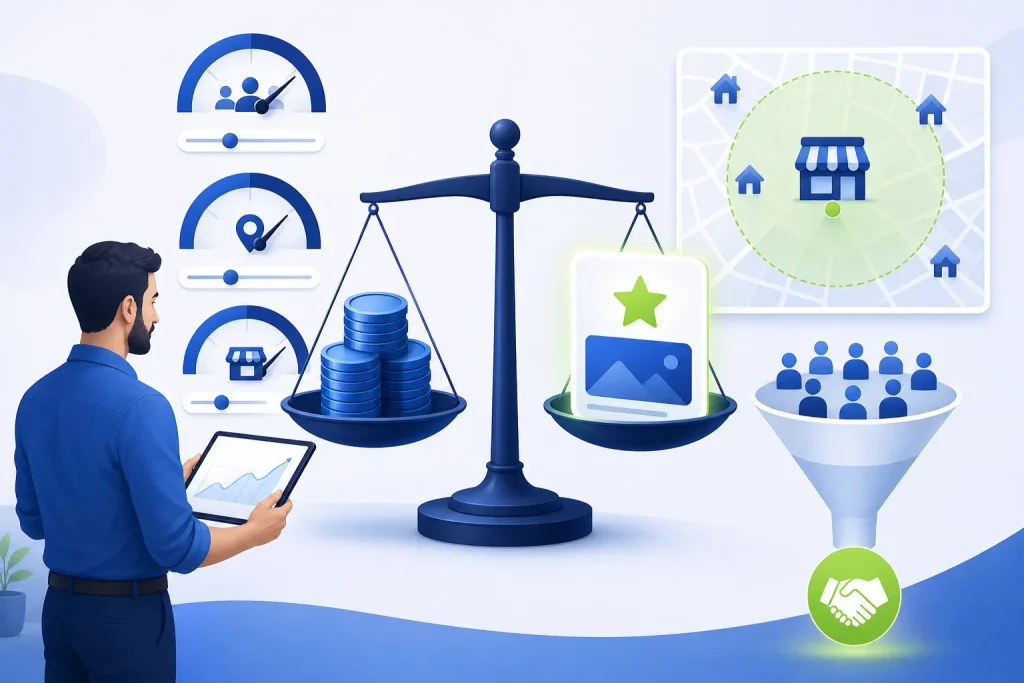
Facebook ads don’t have a set price. You choose the budget, and what each impression, click or lead costs comes out of Meta’s ad auction, which weighs your bid against how relevant your ad is to each person. For a local business, the main things that move cost are audience size, competition and season, creative quality, the campaign objective, placements, your location radius and whether your ads fall under a special ad category. If an agency runs the ads, its management fee is a second cost, separate from the money you pay Meta.
This guide explains how the auction works, what pushes your costs up or down, how ad spend and management differ, and how to judge whether you’re paying too much. You won’t find price lists here, because any number quoted without your market and your goals is a guess. For how we run campaigns, see our Facebook ads management page.
How the Meta Ad Auction Works
Meta explains this in its guide to ad auctions. Each time there’s a chance to show someone an ad, an auction runs. Every ad whose target audience includes that person is eligible to compete.
The winner isn’t simply the highest bidder. Meta says the winning ad is the one with the highest total value, subject to a price floor, and total value combines three factors:
- Bid: what the advertiser is willing to pay to get the result they want.
- Estimated action rates: Meta’s estimate of the probability that showing the ad to that person leads to the result the advertiser chose, such as a lead.
- Ad quality: a measure built from sources such as feedback from people viewing or hiding the ad, and assessments of low-quality attributes like withholding information, sensationalized language and engagement bait.
Meta says estimated action rates and ad quality together measure relevance, and that “an ad that’s more relevant to a person could win an auction against ads with higher bids.” Meta also says auction adjustments won’t cause it to charge you more than your bid. In plain terms: a relevant ad can cost less to show than a weak one, even in the same market.
Ad Relevance Diagnostics
Ads Manager won’t show you a cost score, but it does give ad relevance diagnostics: a quality ranking, an engagement rate ranking and a conversion rate ranking, each compared with ads competing for the same audience. Meta notes these aren’t inputs into the auction itself, but says “ads that are more relevant cost less and see more results.” Low rankings are a sign the creative or the offer needs work.
Budgets and Bid Strategies
You control spend with a budget. Meta explains that a daily budget is an average over the week, not a hard cap, while a lifetime budget is a hard cap for the run of the campaign. Meta is also gradually giving some accounts more daily flexibility, so on some days it may spend more than the daily budget and on others less, within a weekly limit Meta sets.
Your bid strategy tells Meta how to bid for you. Spend-based options such as Highest volume try to get the most results from your budget. Goal-based options such as a cost per result goal aim to keep your average cost near a target, though Meta notes the target isn’t guaranteed. Manual bid caps set the most you’ll bid in any auction.
What Moves the Cost of Facebook Ads
These are the factors we look at first when a local business asks why its Facebook ads cost what they do.
Audience Size
A very small audience gives you fewer auctions to win, and the system has less room to find the people most likely to respond. A broader audience usually gives Meta’s delivery system more to work with. Meta’s guide to the learning phase also matters here: an ad set usually exits learning after about 50 results in the week after its last significant edit, and Meta says ad sets in learning “usually have a higher CPA.” Splitting a small budget across many tiny audiences can keep everything stuck in learning.
Competition and Season
You’re competing with every other advertiser trying to reach the same people, not just businesses like yours. When more advertisers want the same audience, you need more total value to win. That’s why costs often shift around busy retail seasons and during your own industry’s peak, such as air conditioning in summer or tax services in spring.
Creative Quality
Creative feeds straight into the ad quality and estimated action rate parts of the auction. Clear, honest ads that show your real work, your team and your offer tend to earn better relevance. Clickbait works against you: Meta says engagement bait doesn’t improve ad performance and counts as a low-quality attribute. Ads also wear out. If the same people have seen the same ad many times, results usually slip until you refresh it.
Campaign Objective and Performance Goal
Meta has six campaign objectives: Awareness, Traffic, Engagement, Leads, App promotion and Sales. The objective tells the system what result to look for, and the result you optimize for changes what you pay for. An Awareness campaign may show your ad cheaply to many people, and a Traffic campaign may buy cheap clicks, but neither is trying to get you leads. For most local service businesses the Leads objective is the right comparison point. Our guide to Facebook lead ads for service businesses covers the lead setup in detail.
Placements
Your ad can run across Facebook, Instagram and the Meta Audience Network, among other placements. Meta’s guide to how the delivery system uses placements says it aims for the lowest average cost overall, not the lowest cost in each placement, and that one placement looking more expensive “doesn’t necessarily mean it’s inefficient.” Turning placements off can raise your overall cost, so test before cutting them.
Location Radius
A local business usually targets a radius or a list of ZIP codes around its service area. A tight radius in a small town means a small audience, which can push costs up and slow learning. A radius much wider than you really serve wastes money on people you can’t help. Match the targeting to the area your trucks actually drive.
Special Ad Categories
Ads about housing, employment, or financial products and services have to run under a Special Ad Category. For those ads run from or reaching the US, Meta limits or removes age, gender, ZIP or postal code, exclusion targeting, lookalike audiences and saved audiences, and expands the radius on city or pin-drop locations. You lose some of the levers that keep spend focused, so mortgage, real estate and lending advertisers should expect broader audiences and lean harder on creative and offer to qualify people.
Your Offer and What Happens After the Click
Two businesses in the same market can see very different costs per lead because of the offer and the follow-up. A clear reason to act raises response rates, which feeds the estimated action rate. Our guide to choosing an offer for your Facebook ads covers this. Tracking matters too: Meta says using its Conversions API alongside the pixel creates a more reliable connection that helps the delivery system decrease your cost per result.
| Factor | Tends to raise cost | Tends to lower cost |
|---|---|---|
| Audience | Very narrow audiences, many small ad sets | Broader audiences, fewer ad sets with more results each |
| Competition | Peak season, many advertisers chasing the same people | Quieter periods, less crowded audiences |
| Creative | Tired, vague or clickbait ads | Fresh, specific ads that match the audience |
| Objective | Optimizing for a result you don’t really want | Optimizing for leads or qualified leads |
| Placements | Cutting placements based on per-placement cost alone | Letting the system find lower-cost opportunities |
| Location | A tiny radius, or one far wider than you serve | Targeting that matches your real service area |
| Special ad category | Fewer targeting options | Strong creative and offer doing the qualifying |
| Tracking | Missing or broken conversion data | Pixel plus Conversions API, with lead outcomes sent back |
Ad Spend vs Management: Two Separate Costs
When you hire help, you’re paying for two different things, and it’s worth keeping them apart.
- Ad spend is the money Meta charges to show your ads. With Local Blitz, you pay Meta directly from your own ad account, so you can always see exactly what was spent.
- Management is what you pay an agency or consultant to plan, build, run and report on the campaigns. Our management fee is separate from ad spend.
Management is usually priced in one of a few ways. We offer monthly retainers for ongoing campaign management, one-time projects such as an account audit or a tracking setup, and a setup fee plus a monthly fee when there’s a lot of building to do before the campaigns can run well. What drives the management side is the scope: how many services and locations you advertise, how much creative needs to be produced and refreshed, whether forms, CRM connections and the Conversions API need setting up, and how detailed the reporting is.
Our pricing page explains how we scope work, and our article on where SEO pricing comes from walks through the same kind of factor-based thinking for SEO. If you’re weighing Google as well, our guide to budgeting for Google Ads covers that side.
Judge Facebook Ad Costs by Cost per Lead and Cost per Customer, Not CPM
Ads Manager shows plenty of cost metrics. Some describe how cheaply Meta showed your ad. Others describe what you got for the money. For a local service business, the second kind is what counts.
| Metric | What it measures | Why it can mislead |
|---|---|---|
| CPM | Cost per 1,000 impressions | Cheap impressions can reach people who will never hire you |
| CPC | Cost per click | A click isn’t a lead, and some placements drive accidental taps |
| Cost per lead | Ad spend divided by leads | Useful, but a cheap lead that never answers isn’t cheap |
| Cost per booked appointment | Ad spend divided by booked jobs or estimates | Needs lead outcomes tracked in a CRM |
| Cost per customer | Ad spend divided by new paying customers | The closest to real return, and the hardest to track |
To get to cost per customer, you need to know which leads turned into jobs. That means a CRM or at least a spreadsheet with a status for every lead, plus call tracking if people phone you from the ad. Our guide on tracking ad performance for a service business shows how to set that up. Then compare cost per customer with what a customer is worth to you over time. A campaign with a higher cost per lead can be the better one if those leads close more often.
It also helps to compare channels on the same terms. Our article on Google Ads vs Meta Ads for local service businesses looks at how intent differs between the two, and our guide to Performance Max for local businesses covers Google’s all-channel campaign type.
Red Flags When Someone Quotes Facebook Ad Costs
- A guaranteed cost per lead. Costs come from an auction nobody controls. A guarantee usually means the definition of a lead is very loose.
- You don’t own the ad account. If the agency runs your ads from its own account, you can lose your data and history when you leave.
- Ad spend and fees rolled into one number. If you can’t see what Meta was actually paid, you can’t tell what the management costs.
- Reports full of reach, impressions and likes. Those are fine to watch, but a report should show leads, calls and ideally jobs.
- No talk about tracking or follow-up. Without a pixel, the Conversions API and a way to record lead outcomes, nobody knows what a customer costs.
- Constant changes in the first week. Meta warns that significant edits during the learning phase reset learning and delay optimization.
- A long contract before anything is proven. A fair test period is usually enough to see whether the ads can produce customers at a cost that works for you.
Frequently Asked Questions
How much do Facebook ads cost for a local business?
There’s no fixed price. You set the budget, and the cost of each click or lead comes from Meta’s ad auction. Audience size, competition and season, creative quality, the campaign objective, placements, your location radius and special ad category rules all move it. Management is a separate cost if you hire help.
Is there a minimum budget for Facebook ads?
The budget needs to be large enough for Meta’s system to learn. Meta says an ad set usually exits the learning phase after about 50 results in the week after its last significant edit, and recommends realistic budgets. Spreading a small budget across many ad sets makes that harder.
Why did my Facebook ad costs go up?
Common reasons are more competition for your audience, a busy season, ads people have seen too many times, a narrower audience, recent edits that restarted the learning phase, or tracking that stopped sending conversions. Check your ad relevance diagnostics and your conversion data first.
Are Facebook leads cheaper than Google Ads leads?
Sometimes, but the comparison isn’t simple. Google Search reaches people actively looking for a service, while Facebook reaches people while they scroll. Compare cost per booked job or cost per customer, not just cost per lead.
Does my ad budget go to the agency?
Not with Local Blitz. You pay Meta directly from your own ad account, and our management fee is billed separately, so you can always see what was spent on ads.
Do I have to sign a long-term contract?
Not with us. Our plans are month-to-month, and we also take on one-time projects such as audits and tracking setups.
Get a Straight Answer on Your Facebook Ad Costs
Local Blitz has managed digital marketing for local businesses since 2009, from offices in San Diego (Encinitas) and Indianapolis. We’ll look at your market, your offer and your tracking, and tell you what’s likely driving your costs. Ad spend is paid directly to Meta and kept separate from our fee, plans are month-to-month, and there are no cookie-cutter packages. See our Facebook ads management service or book a free strategy call. If Facebook isn’t the right channel for you, we’ll say so.
Is AI recommending your business?
We will ask ChatGPT, Gemini and Google AI about your business and show you what they say. It is free.
Want More Customers From Search?
Book a free strategy call, or call San Diego (858) 225-6877 or Indianapolis (317) 672-1156.