
The types of SEO are the main categories of search engine optimization, grouped by where the work happens: on-page SEO (your content and HTML), off-page SEO (links and mentions on other sites), technical SEO (crawling, speed and indexing), local SEO (Google Maps and your Business Profile) and AEO, which helps AI search tools find and cite you.
Every SEO strategy uses some mix of these. Which ones matter most depends on the visibility you want. A plumber who serves one metro area needs strong local SEO. A national ecommerce store leans harder on technical and on-page work. Most businesses need a bit of everything.
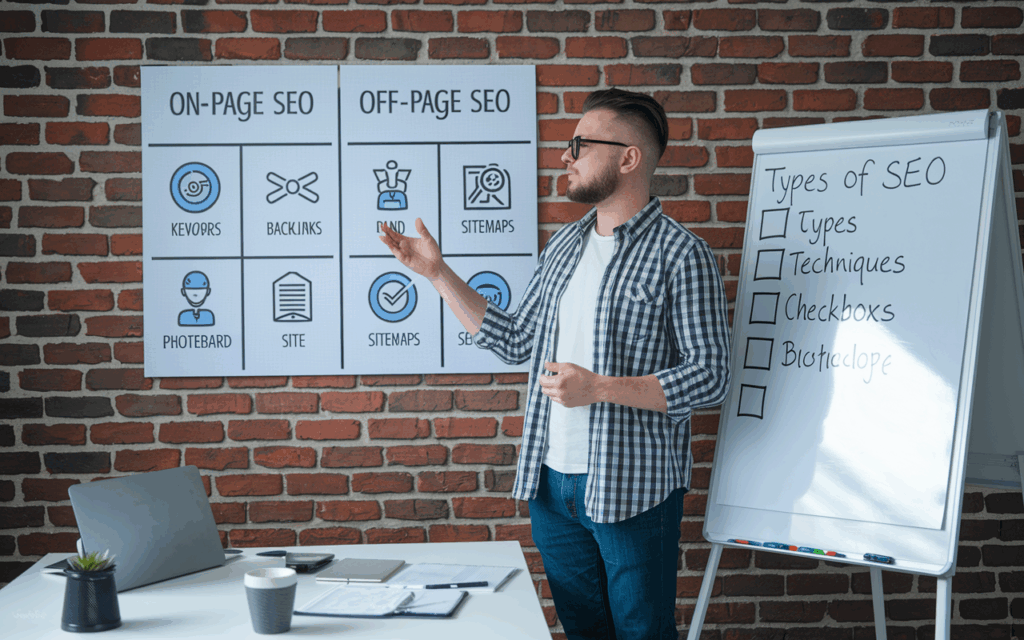
The Types of SEO at a Glance
| Type of SEO | What it covers | Example techniques |
|---|---|---|
| On-page SEO | Everything on your own pages | Keyword research, title tags, headings, content, internal links, image alt text |
| Off-page SEO | Signals from outside your website | Link building, digital PR, citations, reviews, brand mentions |
| Technical SEO | How search engines crawl and index your site | Site speed, Core Web Vitals, mobile usability, XML sitemaps, schema markup |
| Local SEO | Visibility in local and map results | Google Business Profile optimization, reviews, NAP consistency, location pages |
| AEO / AI search | Being understood and cited by AI answers | Answer-first content, entity coverage, structured data, consistent business facts |
What Are SEO Techniques?
Search engine optimization is the practice of earning more visibility in search results so more of the right people find your business. An SEO technique is one specific action within that practice, such as rewriting a title tag, fixing a broken internal link or earning a link from an industry association. The types of SEO are simply the buckets those techniques fall into.
SEO is not limited to your website, either. Your Google Business Profile, your YouTube channel and the listings and reviews that mention you elsewhere can all be optimized, and they all feed how search engines and AI tools see your business.
On-Page SEO
On-page SEO is anything on your own website that affects your search visibility. If it happens on your site and you can control it, it is probably on-page. The key idea is that search engines can’t read the way people do. They rely on structure and signals to understand what a page is about and who it is for.
Common on-page SEO techniques include:
- Keyword research. Choosing the terms each page should target based on what your customers actually search.
- Page titles. Every page needs a unique, descriptive title written for the search you want, never an auto-filled default.
- Meta descriptions. They don’t directly move rankings, but a clear one improves click-through rates.
- Headings. One H1 that states the topic, with H2s and H3s that organize the rest of the page.
- Content. Thorough, useful content that answers the searcher’s question. Compare your page to the pages that already rank and cover the topic at least as well.
- Internal links. Linking related pages together helps search engines understand your site and spreads authority. See why interlinking is important for SEO.
- Images. Compressed files with descriptive alt text.
- URLs and social previews. Short, readable URLs and complete Open Graph tags so your pages look right when shared.
Common On-Page SEO Problems
The most common issue we see is thin content. If a page has far less useful information than the pages already ranking, it will struggle no matter what else you fix. The second is under-optimization: missing H1s, default meta descriptions and titles that don’t mention what the page is about.
The opposite problem exists too. Over-optimized pages stuff the same keyword into every heading, alt tag and sentence. Write naturally for people, use your main term where it fits and cover the related topics a real expert would mention.
Off-Page SEO
Off-page SEO is anything that happens outside your website that affects your search visibility. Most of it comes down to links from other websites, plus citations, reviews and brand mentions.
Links matter because they give search engines context and trust. Say you write a blog post about elephants. Google can tell the post is about elephants, but if an elephant rescue organization links to it, Google has outside confirmation that your post is relevant and worth recommending.
Not all links are equal. A link from a respected, relevant website can help a lot, while links from spammy sites can hurt. That is why we stick to white hat techniques, the methods that follow Google’s guidelines, and avoid black hat shortcuts like paid link schemes that can earn a penalty. Common off-page techniques include:
- Earning links through useful content, partnerships and digital PR (see types of link building)
- Listing your business consistently in reputable directories and citation sites
- Generating and responding to customer reviews
- Getting your brand mentioned on industry and local websites
Technical SEO
Technical SEO makes sure search engines can crawl, render and index your site without problems. It is the least glamorous type of SEO, and clients rarely see it, but without it the rest of your work can’t pay off.
Technical SEO techniques include:
- Improving page speed and Core Web Vitals
- Making sure the site works well on mobile, since Google indexes the mobile version of your pages
- Securing the site with HTTPS
- Submitting an XML sitemap and checking indexing in Google Search Console
- Fixing broken links, redirect chains and duplicate pages with canonical tags
- Adding schema markup so search engines understand your business, services and FAQs
Indexing deserves special attention. It is not automatic, and a page Google hasn’t indexed can’t rank at all. A regular review of Google Search Console will tell you whether your technical SEO is in good shape.
Local SEO
Local SEO helps a business show up in searches with local intent, like “dentist near me” or “HVAC repair Indianapolis,” including the map pack at the top of Google. For businesses that serve a specific area, it is often the type of SEO that brings in the most calls.
Local SEO techniques include:
- Optimizing your Google Business Profile (formerly Google My Business) with the right categories, services, hours and photos
- Earning and replying to reviews. Here is how reviews help Google Business Profile rankings
- Keeping your business name, address and phone number (NAP) consistent across the web
- Creating useful pages for each location or service area you cover
AEO and AI Search Optimization
Answer engine optimization (AEO) is the newest type of SEO. It helps AI tools such as ChatGPT, Google’s AI Overviews, Gemini and Perplexity understand your business and cite it when they answer questions. Many people now ask an AI assistant for a recommendation before they ever click a search result.
AEO builds on good SEO and adds a few techniques of its own:
- Answering the main question directly in the first lines of a page
- Covering the related entities and follow-up questions around a topic
- Using structured data so machines can read your business facts
- Keeping your name, services and locations consistent everywhere you are listed
- Earning mentions on the sites AI tools already trust and cite
Not sure whether AI tools recommend you? Try our free AI visibility check.
Other Types of SEO You May Hear About
You will also see terms like ecommerce SEO, content SEO, video or YouTube SEO and mobile SEO. These are specializations that combine the main types for a particular kind of site or platform. White hat and black hat SEO describe whether the techniques follow search engine guidelines, so they apply across all of the types above.
On-Page vs Off-Page SEO: Where to Start
Both matter, but on-page and technical SEO are the foundation. If your pages are thin, poorly structured or hard for Google to crawl, no amount of link building will fix them. Start by getting your key pages right, then build off-page authority on top.
A practical order for most businesses:
- Fix technical problems that block crawling or indexing.
- Optimize your most important service and location pages.
- Set up and complete your Google Business Profile if you serve local customers.
- Publish content that answers your customers’ questions.
- Earn links, citations and reviews.
Current Considerations for Organic SEO
The techniques above have been around for years, but the way search engines weigh them keeps changing. A few things stand out right now:
- Helpful, experienced content wins. Google rewards pages written for people by someone who knows the subject. Our post on E-E-A-T guidelines explains what that means.
- User experience counts. Fast, mobile-friendly pages that are easy to navigate keep visitors around and support rankings.
- Search intent comes first. Match the type of page searchers expect, whether that is a guide, a service page or a local listing.
- Search is spreading out. People find businesses through Google, Maps, YouTube and AI assistants, so SEO now covers all of them.
- Measure everything. Use Google Search Console and Google Analytics to see which queries and pages bring in leads, then adjust.
Types of SEO FAQ
How many types of SEO are there?
Most experts group SEO into four core types: on-page, off-page, technical and local. AEO, or AI search optimization, is now widely treated as a fifth. Other labels, like ecommerce or video SEO, are specializations within these.
What are the two main types of SEO in digital marketing?
The two original types are on-page SEO, which covers your own pages, and off-page SEO, which covers links and signals from other sites. Technical SEO is sometimes counted as part of on-page.
What are SEO techniques?
SEO techniques are the specific actions used to improve search visibility, such as keyword research, optimizing title tags, improving page speed, earning backlinks and optimizing a Google Business Profile.
Which type of SEO should I start with?
Start with technical and on-page SEO so your site is a solid foundation. If you serve a local area, work on local SEO and your Google Business Profile at the same time. Then add off-page work like link building.
Is AEO replacing SEO?
No. AI search tools draw on many of the same signals as traditional search, such as clear content, structured data and trusted mentions. AEO extends SEO so your business shows up in AI answers as well as search results.
Get an SEO Strategy That Uses the Right Mix
Every business needs a different blend of on-page, off-page, technical, local and AI search work. Local Blitz builds custom SEO strategies from our offices in Indianapolis and San Diego. Book a free strategy call and we’ll show you where to start, or run a free AI visibility check to see how AI tools describe your business today.
Is AI recommending your business?
We will ask ChatGPT, Gemini and Google AI about your business and show you what they say. It is free.
Want More Customers From Search?
Book a free strategy call, or call San Diego (858) 225-6877 or Indianapolis (317) 672-1156.