
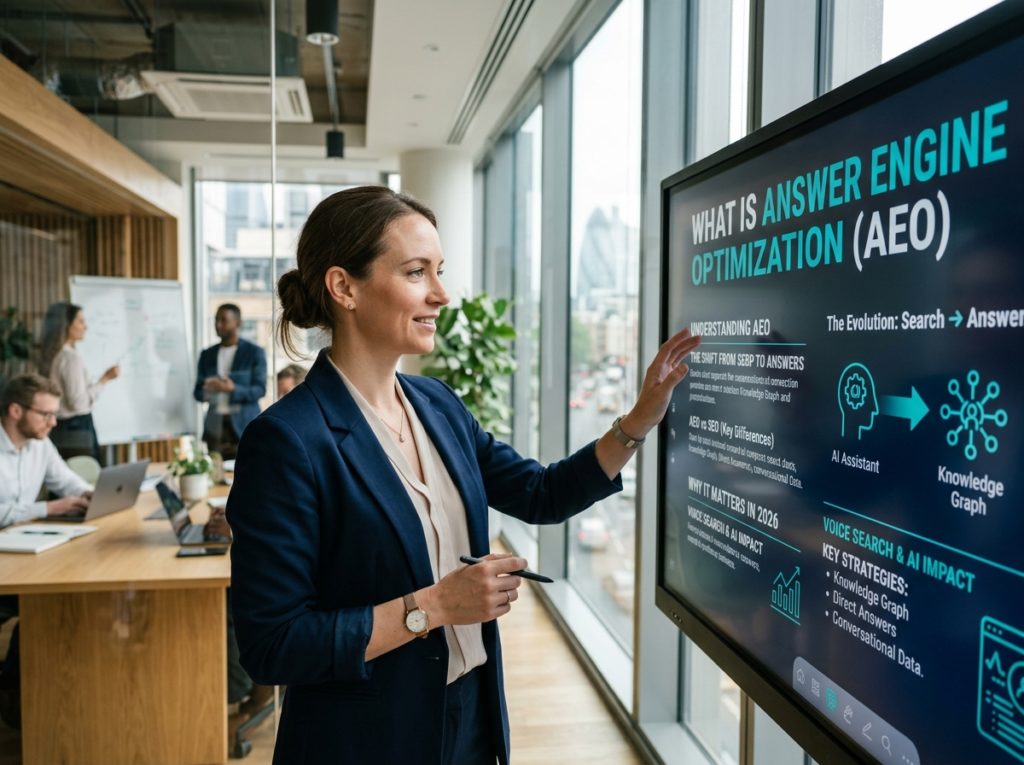

Answer Engine Optimization (AEO) is the practice of structuring content so AI-powered search systems can extract, understand, and cite it as a direct answer. Unlike traditional Search Engine Optimization (SEO), which targets ranking positions on a search engine results page (SERP), AEO targets inclusion inside AI-generated answers, featured snippets, and voice assistant responses. As of 2025, platforms like ChatGPT, Perplexity AI, Google AI Overviews, and Google's Search Generative Experience (SGE) increasingly answer queries directly—without requiring a click.
Why Answer Engine Optimization Matters in 2026

Search behavior is shifting from keyword typing to natural language queries and conversational search. According to Gartner (2024), organic search traffic to websites may decline by 25% by 2026 as users rely more on AI chatbots and answer engines. This zero-click search trend means brands must optimize not just for rankings, but for citation within AI-generated answers.
Google, Bing, and emerging AI-powered search tools like Bard and Gemini now pull directly from structured, high-authority content. Businesses that ignore AEO strategy risk losing digital visibility even if their traditional SEO rankings remain strong.
Key Characteristics of Answer Engine Optimization
1. Structured Data and Schema Markup
AEO relies heavily on schema.org markup and structured data to help large language models (LLMs) parse content accurately. Structured data markup clarifies entity relationships, definitions, and facts for machine readability.
2. Conversational and Natural Language Optimization
Content must answer natural language queries the way a person would ask them aloud—mirroring voice search optimization patterns used by Alexa, Siri, and Google Assistant.
3. E-E-A-T Signals
Google's E-E-A-T framework—Experience, Expertise, Authoritativeness, and Trustworthiness—remains central to content authority and website authority in AI-driven ranking systems.
4. Semantic Search Alignment
Semantic SEO and semantic search focus on topical relevance and search intent rather than exact-match keywords, helping answer engines understand query understanding at a conceptual level.
5. Direct-Answer Formatting
Content built for featured snippet optimization and answer box optimization uses concise, front-loaded answers—typically under 50 words—for maximum extractability.
How Answer Engine Optimization Works
- Query Understanding: AI chatbots and answer engines use Natural Language Processing (NLP) to interpret user intent behind a query.
- Content Retrieval: Search algorithms scan indexed pages for information retrieval based on topical relevance and authority.
- Entity Matching: Systems cross-reference content against a Knowledge Graph to verify facts and relationships.
- Structured Extraction: Structured data markup and schema markup help isolate direct answers, lists, and definitions.
- Answer Generation: Generative search results synthesize the most authoritative, well-structured content into a conversational response.
Learn more about what is answer engine optimization and how it applies to local business visibility strategies.
Common Misconceptions About AEO
| Myth | Reality |
|---|---|
| AEO replaces SEO entirely. | AEO builds on technical SEO and on-page SEO foundations; it doesn't eliminate them. |
| AEO only applies to voice search. | AEO covers AI Overviews, chatbots, knowledge panels, and rich snippets—not just voice assistants. |
| Keyword stuffing still works for AEO. | Answer engines prioritize search intent and content authority over keyword density. |
| Only large brands benefit from AEO. | An AEO strategy for small businesses in 2026 can improve local digital visibility significantly. |
AEO vs SEO vs GEO (Generative Engine Optimization)
| Factor | SEO | AEO | GEO |
|---|---|---|---|
| Primary Goal | Rank on SERP | Get cited in direct answers | Appear in generative AI search outputs |
| Target Platform | Google, Bing | ChatGPT, Perplexity AI, AI Overviews | Bard, Gemini, generative engines |
| Content Format | Long-form pages | Concise, structured direct answers | Narrative, context-rich passages |
| Key Signal | Backlinks, keywords | Schema markup, E-E-A-T | Semantic depth, citations |
How does AEO differ from SEO in practice? SEO optimizes for click-through rate on a results page; AEO optimizes for being the answer itself, reducing reliance on user clicks altogether.
Practical Applications of Answer Engine Optimization
Optimizing FAQs for Answer Engines
Structuring FAQ pages with schema markup increases the likelihood of appearing in Google's featured snippets and knowledge panels.
Optimizing Content for Google AI Overviews
Content should include clear definitions, numbered steps, and cited data to align with how Google AI Overviews synthesize generative search results.
AEO Techniques for Voice Search
Writing in a conversational tone that mirrors spoken queries improves compatibility with voice assistants like Alexa and Google Assistant.
Optimizing for ChatGPT Search Results
Publishing authoritative, well-sourced content with clear entity relationships increases the odds of citation by AI chatbots and conversational AI tools.
AEO Implementation Checklist for 2026
- Add structured data markup to all key pages.
- Write direct, quotable answers within the first 100 words of each section.
- Strengthen E-E-A-T through author bios and cited sources.
- Use consistent terminology and define industry terms clearly.
- Monitor search algorithm updates affecting AI-generated answers.
As search engines evolve toward answer-first experiences, brands that adopt AEO best practices now will maintain content discoverability and search visibility well beyond 2026.